College of Sciences

Latest News

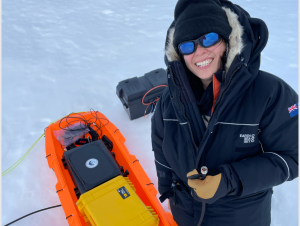
Winnie Chu

The grant will support Chu as she uses radar data and generative AI to map temperatures beneath the Antarctica ice sheet, aiming to improve climate predictions, support coastal planning, and train future scientists through open-access tools and education.
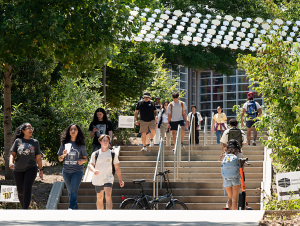
Students walking on Georgia Tech's campus

The new bachelor’s degree brings together essential elements of both mathematics and computing training and includes the applications of mathematical theories relevant to computing and data, as well as the theoretical problems and real-world challenges that modern computing addresses.  

Sustainability Next Plan document

The 2025 round of Sustainability Next Research Seed Grants has been awarded to 17 transdisciplinary research teams representing a vibrant network of 51 collaborators from across Georgia Tech. These teams span 21 unique units from six of the seven Colleges, including Schools, research centers, and Interdisciplinary Research Institutes. 
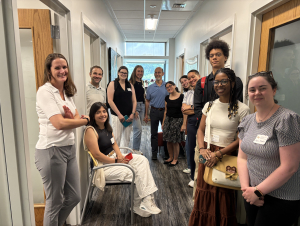
The first cohort of the Neuroscience and Neurotechnology Ph.D. Program were welcomed to campus during a launch event in August 2025.

The inaugural cohort of Georgia Tech’s Ph.D. program in Neuroscience and Neurotechnology includes both transfers from other Georgia Tech graduate programs and students new to the Institute. 
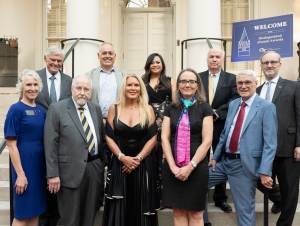
(First row, left to right): Susan Lozier, John Clark Sutherland, Kelly Sepcic Pfeil, Margaret Beier, and Rutt Bridges. (Second row, left to right): Jack McCallum, Angel Cabrera, Kristel Bayani Topping, Frank Cullen, and Nathan Meehan.

The College of Sciences’ community came together to celebrate the inaugural Distinguished Alumni Awards, recognizing the diverse achievements and inspiring journeys of eight alumni.
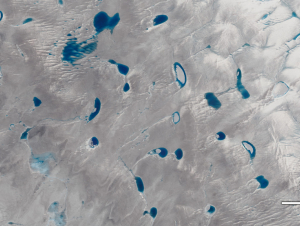
A view of Greenland's ice sheet from the NASA/USGS Landsat 8 satellite showing meltwater lakes on a glacier. (Credit: NASA)

Simple equations are revealing how topography controls supraglacial lake size in Antarctica — and why it matters for climate predictions.
Experts In The News

Alex Robel, an associate professor in the School of Earth and Atmospheric Sciences at Georgia Tech, said pumping sand onshore is far from a perfect solution to stabilize a beach, but it’s “one of the best tools we have in our arsenal.”

“It’s been done in the United States for almost a century in different places and we know how to do it,” Robel said. “We’re good at it.”

But nourishment is only a Band-Aid for erosion. Once cities start replenishing sand, Robel said they have to keep doing it regularly. 

Atlanta Journal Constitution March 24, 2026

A team of researchers including David Hu, a professor in Georgia Tech’s School of Biological Sciences and George W. Woodruff School of Mechanical Engineering, have visualized mosquito flight behavior for the first time.

Based on their data, the researchers said they don’t think mosquitoes swarm because they’re following the pack. Each appeared to pick up on the cues independently, then found themselves at the same place at the same time.

“It’s like a crowded bar,” said Hu. “Customers aren’t there because they followed each other into the bar. They’re attracted by the same cues: drinks, music, and the atmosphere. The same is true of mosquitoes. Rather than following the leader, the insect follows the signals and happens to arrive at the same spot as the others. They’re good copies of each other.”

A similar story was published by The Economic Times.

ScienceDaily March 22, 2026

Upcoming Events

Apr
02
2026
From satellites and rovers to bold visions for human exploration, this year’s program brings together more than two dozen leading scientists, engineers, and thought leaders who are pushing the boundaries of what lies beyond.
Apr
02
2026
In this hands-on workshop we will discuss how to transform your research into a clear and compelling poster.
Apr
02
2026
On the grounds between the Howey and Mason Buildings, several telescopes are typically set up for viewing, and visitors are also invited to bring their own telescope.
Apr
02
2026
On the grounds between the Howey and Mason Buildings, several telescopes are typically set up for viewing, and visitors are also invited to bring their own telescope.
Apr
03
2026
Join the Spatial Ecology and Paleontology Lab for Fossil Fridays! Become a fossil hunter and help discover how vertebrate communities have changed through time.

Spark: College of Sciences at Georgia Tech

Welcome — we're so glad you're here. Learn more about us in this video, narrated by Susan Lozier, College of Sciences Dean and Betsy Middleton and John Clark Sutherland Chair.