College of Sciences

Latest News

Students say the course, APPH 1040: Scientific Foundations of Health, has provided helpful tools to succeed in college.

The newly redesigned course, APPH 1040: Scientific Foundations of Health, expands the Institute’s First-Year Wellness Experience and provides students with practical wellness tools and strategies for college life and beyond.

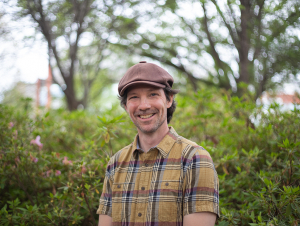
Molei Tao holding his College of Sciences Faculty Development Award during the 2022 Spring Sciences Celebration.

School of Mathematics Associate Professor Molei Tao has been honored for his work on the foundations of machine learning, particularly diffusion generative models. 

School of Physics Professor Ignacio Taboada has been awarded over $1.5 million in funding to build P-ONE’s sensor trigger system.

Ignacio Taboada has been awarded an NSF grant to build a sensor trigger system for the Pacific Ocean Neutrino Experiment — a powerful neutrino detector that will be built more than 2,600 meters under the surface of the Pacific Ocean, providing a new window into neutrino astrophysics.

Animation-for-AF2Complex-Story-V2.gif

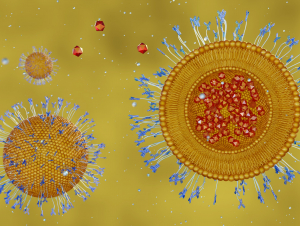
Researchers combine deep learning with advanced sequencing techniques to predict how antibodies interact with antigens.

New College of Sciences ARCS Scholars (from left to right): Alivia Eng, Marrissa Izykowicz, Zach Mobille, and John Pederson.

Highlighting their potential to make significant contributions to science and technology, four College of Sciences Ph.D. candidates have earned the prestigious Achievement Rewards for College Scientists (ARCS) Foundation Scholar Award. The new scholars join three returning College of Sciences ARCS recipients.

D2B2 was created almost entirely by artificial intelligence.

The School of Psychology, led by Chair Tansu Celikel, has launched Deep Dive into Brain and Behavior (D2B2), an AI-generated podcast that distills the School's latest research in psychology and neuroscience into engaging, easy-to-understand episodes. Using Google's NotebookLM, the podcast aims to make complex scientific findings accessible to a wide audience, from students to experts, while maintaining accuracy through author reviews.

Experts In The News

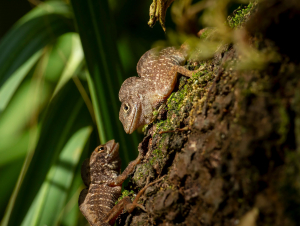
Green iguanas (Iguana iguana) are not native to the U.S. but were brought to Florida in the 1960s, where they have, for the most part, flourished—except, that is, when temperatures have dropped below 50 degrees F (10 degrees C). 

These chilly conditions can cause a cold shock in the lizards. And because the iguanas tend to sleep in trees, getting cold shocked can sometimes cause the animals to fall from the skies in an infamous Florida phenomenon. 

“These tropical lizards were experiencing conditions that they’ve never experienced in their entire evolutionary history before, tens of millions of years,” says James Stroud, an evolutionary biologist at the Georgia Institute of Technology.

But in Florida, colder conditions occur every few years—albeit less often as temperatures rise because of climate change. The experience of the iguanas that have been forced to confront the cold in the state can teach scientists more about how animals respond to new climates more generally, Stroud says.

Scientific American January 16, 2026

Jennifer Glass, professor in the School of Earth and Atmospheric Sciences, was recently quoted in an article published in Scientific American that discusses the evolution of Wikipedia:

As Wikipedia’s use grew, some educators softened their stance, encouraging its use to find leads to sources that students could dig into directly. Others took a different approach, assigning students to edit Wikipedia entries—many through Wiki Education.

Jennifer Glass, a biogeochemist at Georgia Institute of Technology, is one of those professors; she has incorporated Wikipedia editing into her teaching since 2018. She wanted a student project that emphasized the concise and technical but understandable writing style that the site uses. And although she hadn’t done much editing for Wikipedia herself, she was impressed by the website’s breadth of content.

Each semester, her students write one article from scratch about a topic they research, from dolomitization to the tropopause. Glass says the project teaches them the value of institutional access to published literature and the skill of fact-checking their writing line by line.

Scientific American January 15, 2026

Upcoming Events

Feb
13 to 20
2026
Feb
18
2026
Featuring | Ganesh Sundaramoorthi - Senior Research Fellow/Director of Research at RTX Technology Research Center
Feb
19
2026
Leaders and trainees across academia, research, and clinical practice to share their experiences and offer guidance for undergraduate students exploring future careers.
Feb
20
2026
Join the Spatial Ecology and Paleontology Lab for Fossil Fridays! Become a fossil hunter and help discover how vertebrate communities have changed through time.
Feb
20
2026
EAS 1600 students maintain the Library, and it's open to everyone on Fridays from 3:30 - 4:30 pm when classes are in session. Come learn about houseplants and bring your own plant home!

Spark: College of Sciences at Georgia Tech

Welcome — we're so glad you're here. Learn more about us in this video, narrated by Susan Lozier, College of Sciences Dean and Betsy Middleton and John Clark Sutherland Chair.