College of Sciences

Latest News

Andrea L. Laliberte's vision will come to life, promoting awareness and public recognition of the history of Georgia Tech women in a visually compelling way.

Set to open this fall, a permanent tribute will celebrate an inaugural group of 70 graduates, as well as 98 women and events with historical significance to the Institute.

Rime El Asmar

In honor of Women’s History Month, the Georgia Tech Scheller College of Business celebrates some of the women in TI:GER as they share their backgrounds and experiences in the transformative program.

2024 FINALISTs 2update.png

12 grad students named as finalists for 2024 Three Minute Thesis Competition.

Andrew McShan

The two-year grant will support McShan’s innovative research on lipid-based immunotherapies, which could help develop the next generation of universal immunotherapies.

4-Human Brain.jpeg

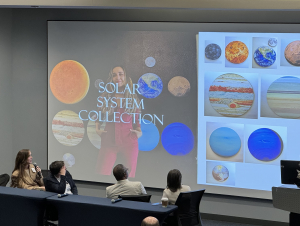
Science and Engineering Day at the Institute included more than 45 exhibitions and interactive demonstrations, hosted by Tech faculty, staff, and students. The highlight of the event was a presentation by alumnus and former NASA astronaut Shane Kimbrough, who shared with audiences his experience of living and working in space. 

Anna (Anya) Ivanova

A new study co-led by School of Psychology's Anna (Anya) Ivanova uncovers the relationship between language and thought in artificial intelligence models like ChatGPT, leveraging cognitive neuroscience research on the human brain. The results are a roadmap to developing new AIs — and to better understanding how we think and communicate.

Experts In The News

Can Alzheimer’s disease be slowed by flickering lights and sound?

That is the question that drives Annabelle Singer, a McCamish Foundation Early Career Professor in the Wallace H. Wallace H. Coulter Department of Biomedical Engineering at Georgia Tech and Emory University. In her lab on Tech’s campus in Atlanta, Singer is trying to better understand patterns of neural activity in the brain and what goes wrong with Alzheimer’s patients. Building on that knowledge, she hopes to develop new ways to treat the disease.

“We are taking a really different approach to Alzheimer’s,” she said. “We’ve determined how neural activity that is essential for memory fails in Alzheimer’s disease. We’re then using that information to develop brain stimulation that could improve brain health.”

CNN February 16, 2026

Until now, no one had built a synthetic material that could simultaneously absorb chemical building blocks, polymerize them into its own network, relieve the mechanical stresses that accumulate during the process, and reverse the whole sequence on demand. A new study published in Advanced Materials ("Rewriting Polymer Fate via Chemomechanical Coupling") reports a polymer platform that accomplishes exactly that. A team at the Georgia Institute of Technology including Associate Professor Will Gutekunst of the School of Chemistry and Biochemistry, with collaborators at North Carolina State University, created what they call a "living" polymer: a material that can grow, shrink, heal, change its stiffness by roughly 100-fold, and be recycled back to raw monomers, all post-fabrication.

Nanowerk News February 12, 2026

Upcoming Events

Feb
13 to 20
2026
Feb
19
2026
Leaders and trainees across academia, research, and clinical practice to share their experiences and offer guidance for undergraduate students exploring future careers.
Feb
20
2026
Join the Spatial Ecology and Paleontology Lab for Fossil Fridays! Become a fossil hunter and help discover how vertebrate communities have changed through time.
Feb
20
2026
EAS 1600 students maintain the Library, and it's open to everyone on Fridays from 3:30 - 4:30 pm when classes are in session. Come learn about houseplants and bring your own plant home!
Feb
23
2026
Monthly open discussions about the direction and development of AI.

Spark: College of Sciences at Georgia Tech

Welcome — we're so glad you're here. Learn more about us in this video, narrated by Susan Lozier, College of Sciences Dean and Betsy Middleton and John Clark Sutherland Chair.