
College of Sciences

Latest News

Sea cucumbers and coral

In a first-of-its-kind study, researchers at the Georgia Institute of Technology discovered that sea cucumbers — sediment-eating organisms that function like autonomous vacuum cleaners of the ocean floor — play an enormous role in protecting coral from disease. 

The campus community is invited to participate in a week of events that increase awareness of and encourage actions that advance the 17 United Nations Sustainable Development Goals. 

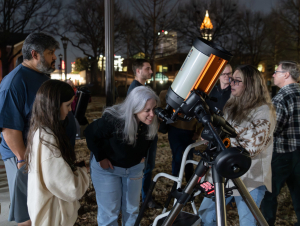
James Sowell, director of the Georgia Tech Observatory. Photo: Rob Felt

This year brings another February 29. Why do leap years occur? Jim Sowell is a principal academic professional in the School of Physics and the director of the Georgia Tech Observatory. He says the leap year’s creation goes back to Julius Caesar.

Sloan Researchers

Sloan Fellowships are among the most prestigious awards for early career faculty

Georgia Tech Energy Materials Day 2024

Energy materials facilitate the conversion or transmission of energy. They also play an essential role in how we store energy, reduce power consumption, and develop cleaner, efficient energy solutions.

Chunhui (Rita) Du and Alex Blumenthal

Mathematician Alex Blumenthal and Physicist Chunhui (Rita) Du are among 126 early-career researchers who have been awarded prestigious Sloan Research Fellowships for 2024. This year’s appointees also include Georgia Tech faculty Juan-Pablo Correa-Baena of the College of Engineering, and Daniel Genkin of the College of Computing. 

Experts In The News

Can Alzheimer’s disease be slowed by flickering lights and sound?

That is the question that drives Annabelle Singer, a McCamish Foundation Early Career Professor in the Wallace H. Wallace H. Coulter Department of Biomedical Engineering at Georgia Tech and Emory University. In her lab on Tech’s campus in Atlanta, Singer is trying to better understand patterns of neural activity in the brain and what goes wrong with Alzheimer’s patients. Building on that knowledge, she hopes to develop new ways to treat the disease.

“We are taking a really different approach to Alzheimer’s,” she said. “We’ve determined how neural activity that is essential for memory fails in Alzheimer’s disease. We’re then using that information to develop brain stimulation that could improve brain health.”

CNN February 16, 2026

Until now, no one had built a synthetic material that could simultaneously absorb chemical building blocks, polymerize them into its own network, relieve the mechanical stresses that accumulate during the process, and reverse the whole sequence on demand. A new study published in Advanced Materials ("Rewriting Polymer Fate via Chemomechanical Coupling") reports a polymer platform that accomplishes exactly that. A team at the Georgia Institute of Technology including Associate Professor Will Gutekunst of the School of Chemistry and Biochemistry, with collaborators at North Carolina State University, created what they call a "living" polymer: a material that can grow, shrink, heal, change its stiffness by roughly 100-fold, and be recycled back to raw monomers, all post-fabrication.

Nanowerk News February 12, 2026

Upcoming Events

Feb
13 to 20
2026
Feb
19
2026
Leaders and trainees across academia, research, and clinical practice to share their experiences and offer guidance for undergraduate students exploring future careers.
Feb
20
2026
Join the Spatial Ecology and Paleontology Lab for Fossil Fridays! Become a fossil hunter and help discover how vertebrate communities have changed through time.
Feb
20
2026
EAS 1600 students maintain the Library, and it's open to everyone on Fridays from 3:30 - 4:30 pm when classes are in session. Come learn about houseplants and bring your own plant home!
Feb
23
2026
Monthly open discussions about the direction and development of AI.

Spark: College of Sciences at Georgia Tech

Welcome — we're so glad you're here. Learn more about us in this video, narrated by Susan Lozier, College of Sciences Dean and Betsy Middleton and John Clark Sutherland Chair.