College of Sciences

Latest News

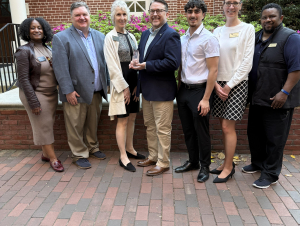
1st row, from L to R: Ria Vittal, Malavika Niverth; 2nd row: Meghan Hamrick, Britney Huynh, Andrea Ninh; 3rd row: Larissa Martin, Anja Govednik; 4th row: Alison Bolaños, J’Avani Stinson, Deandra Smith.

Congratulations to the inaugural class of College of Sciences undergraduate student ambassadors!

17C1001-P7-047-Web-Use---1-000px-Wide.jpg

Georgia Tech Researchers Among World’s Most Highly Cited in 2025

Jacob Adler (left) and Sharissa Thompson (right) conducting research.

New research is showing that atmospheric pressure shifts dramatically altered how mud and water flowed on Mars — sometimes boiling, sometimes freezing — offering fresh clues to reconstruct the planet's ancient climate and habitability.

Alexander Cachine

Cachine was selected for his work in solving modern medical challenges using ancient textile techniques. 

The Tower, Spring 2025 Edition

The Tower, Georgia Tech’s undergraduate research journal, is seeking submissions from students across all disciplines who want to have their work published in a campuswide platform. 

Benjamin Manoj (front) and other Yellow Jackets Against Poverty members dig holes for the foundation of a new homeless shelter.

Fighting poverty and fostering kindness, the student-led Yellow Jackets Against Poverty Club makes a hands-on difference in the lives of those in need. 

Experts In The News

Green iguanas (Iguana iguana) are not native to the U.S. but were brought to Florida in the 1960s, where they have, for the most part, flourished—except, that is, when temperatures have dropped below 50 degrees F (10 degrees C). 

These chilly conditions can cause a cold shock in the lizards. And because the iguanas tend to sleep in trees, getting cold shocked can sometimes cause the animals to fall from the skies in an infamous Florida phenomenon. 

“These tropical lizards were experiencing conditions that they’ve never experienced in their entire evolutionary history before, tens of millions of years,” says James Stroud, an evolutionary biologist at the Georgia Institute of Technology.

But in Florida, colder conditions occur every few years—albeit less often as temperatures rise because of climate change. The experience of the iguanas that have been forced to confront the cold in the state can teach scientists more about how animals respond to new climates more generally, Stroud says.

Scientific American January 16, 2026

Jennifer Glass, professor in the School of Earth and Atmospheric Sciences, was recently quoted in an article published in Scientific American that discusses the evolution of Wikipedia:

As Wikipedia’s use grew, some educators softened their stance, encouraging its use to find leads to sources that students could dig into directly. Others took a different approach, assigning students to edit Wikipedia entries—many through Wiki Education.

Jennifer Glass, a biogeochemist at Georgia Institute of Technology, is one of those professors; she has incorporated Wikipedia editing into her teaching since 2018. She wanted a student project that emphasized the concise and technical but understandable writing style that the site uses. And although she hadn’t done much editing for Wikipedia herself, she was impressed by the website’s breadth of content.

Each semester, her students write one article from scratch about a topic they research, from dolomitization to the tropopause. Glass says the project teaches them the value of institutional access to published literature and the skill of fact-checking their writing line by line.

Scientific American January 15, 2026

Upcoming Events

Feb
06
2026
Join the Spatial Ecology and Paleontology Lab for Fossil Fridays! Become a fossil hunter and help discover how vertebrate communities have changed through time.
Feb
06
2026
EAS 1600 students maintain the Library, and it's open to everyone on Fridays from 3:30 - 4:30 pm when classes are in session. Come learn about houseplants and bring your own plant home!
Feb
12
2026
This event series aims to showcase research taking place in the College of Sciences to the wider science community.

Spark: College of Sciences at Georgia Tech

Welcome — we're so glad you're here. Learn more about us in this video, narrated by Susan Lozier, College of Sciences Dean and Sutherland Chair.