To request a media interview, please reach out to experts using the faculty directories for each of our six schools, or contact Jess Hunt-Ralston, College of Sciences communications director. A list of faculty experts is also available to journalists upon request.
News Center
Latest News
In her senior year in the School of Earth and Atmospheric Sciences, Devon Robinson joined fellow students in writing and illustrating a children's book about the deep ocean. Now, their class project "Ocean Adventures with Millie and Sam" will help NOAA with science communications outreach to encourage budding scientists.

Christopher Jones, Sandra Magnus, and Nick Sahinidis join Nathan Meehan (Phys '75) and Nick Lappos (AE ’73) in being elected to the NAE, one of the highest professional distinctions awarded to an engineer.
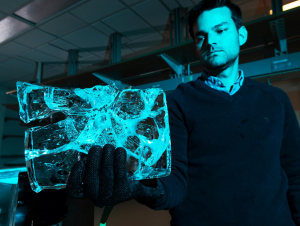
Alexander Robel leads a new study projecting that warm seawater — seeping under certain glaciers — could eventually lead to future sea level rise that’s double that of existing estimates, with new findings published in The Cryosphere.
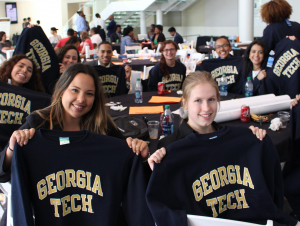
The College of Engineering’s Center for Engineering Education and Diversity (CEED) will double the number of students in its annual summer research program thanks to a new partnership with Amazon. The company is committing $730,000 to support CEED’s Summer Undergraduate Research Experience (SURE) during the next two years.

In early 2020, Georgia Tech researchers designed a saliva-based polymerase chain reaction (PCR) test and encouraged community members to test weekly to track the health of the campus.

Researchers demonstrate that new physical theories provide precise predictions of the deformations of certain structures, revealing that a flexible mechanical structure is governed by some of the same math as electromagnetic waves and even black holes.
Experts In The News
Alex Robel, an associate professor in the School of Earth and Atmospheric Sciences at Georgia Tech, said pumping sand onshore is far from a perfect solution to stabilize a beach, but it’s “one of the best tools we have in our arsenal.”
“It’s been done in the United States for almost a century in different places and we know how to do it,” Robel said. “We’re good at it.”
But nourishment is only a Band-Aid for erosion. Once cities start replenishing sand, Robel said they have to keep doing it regularly.
Atlanta Journal Constitution March 24, 2026A team of researchers including David Hu, a professor in Georgia Tech’s School of Biological Sciences and George W. Woodruff School of Mechanical Engineering, have visualized mosquito flight behavior for the first time.
Based on their data, the researchers said they don’t think mosquitoes swarm because they’re following the pack. Each appeared to pick up on the cues independently, then found themselves at the same place at the same time.
“It’s like a crowded bar,” said Hu. “Customers aren’t there because they followed each other into the bar. They’re attracted by the same cues: drinks, music, and the atmosphere. The same is true of mosquitoes. Rather than following the leader, the insect follows the signals and happens to arrive at the same spot as the others. They’re good copies of each other.”
A similar story was published by The Economic Times.
ScienceDaily March 22, 2026