College of Sciences

Latest News

23-R10400-P67-004-Web Use - 1,000px Wide.jpg

April is Earth Month with a full calendar of events open to the campus community.
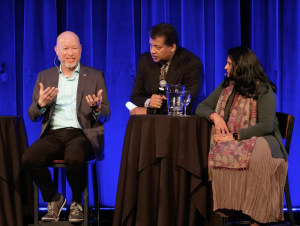
John Wise, left, speaks at the 2024 Asimov Debate

Wise, a professor in the School of Physics and director of the Center for Relativistic Astrophysics, spoke to how the James Webb Space Telescope has impacted astrophysics and our understanding of the formation of galaxies and black holes — a research area he specializes in at Georgia Tech.
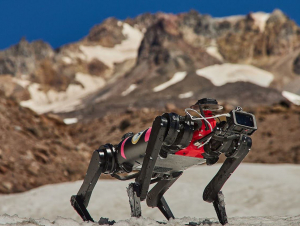
The LASSIE Project’s robot, dubbed Spirit, can “feel” and interpret surface force responses via leg-terrain interactions, assisting planetary scientists with data collection at Oregon’s Mount Hood, a lunar-analog site. (Justin Durner/LASSIE Project)

Scientists at Georgia Tech have teamed up with the University of Southern California (USC), University of Pennsylvania, Texas A&M, Oregon State, Temple University, and NASA Johnson Space Center to teach dog-like robots to navigate craters of the Moon and other challenging planetary surfaces in research funded by NASA.
13C5438-P1-040-Web Use - 1,000px Wide.jpg

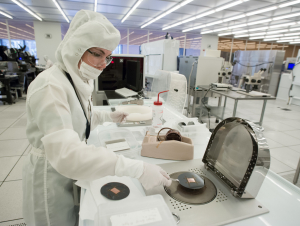
Georgia Tech is supporting career growth for its research faculty, who do critical work at the heart of the research enterprise.

Georgia Tech students witness the 2017 total solar eclipse on campus.

While outside of the path of totality, the Georgia Tech community can still take part in the historic April total solar eclipse.  
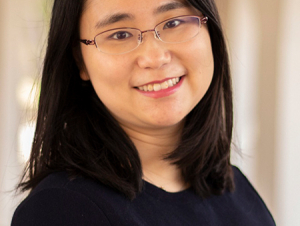
Chunhui (Rita) Du

Chunhui (Rita) Du has been awarded a $652,965 grant by the U.S. Department of Energy for her research into quantum sensing. “The project has the potential to make important contributions to the burgeoning field of quantum materials,” says Du, “and to significantly promote the role of topological magnets in developing next-generation, transformative information technologies.”
Experts In The News

In December, The Conversation hosted a webinar on AI’s revolutionary role in drug discovery and development. Science and technology editor Eric Smalley interviewed Jeffrey Skolnick, Regents' Professor and eminent scholar in computational systems biology at Georgia Institute of Technology, and Benjamin P. Brown, assistant professor of pharmacology at Vanderbilt University. Skolnick has developed AI-based approaches to predict protein structure and function that may help with drug discovery and finding off-label uses of existing drugs. Brown’s lab works on creating new computer models that make drug discovery faster and more reliable.

The Conversation April 7, 2026

While it often gets written off as being distracted or not paying attention, daydreaming is actually a sign of an active and imaginative mind. In fact, a 2017 study found that daydreamers are generally smarter than their focused peers. “People with efficient brains may have too much brain capacity to stop their minds from wandering,” said Eric Schumacher, the Georgia Tech psychology professor who co-authored the study.

People who daydream frequently have things running through their heads, whether they are thinking through ideas or picturing possible outcomes. Letting the mind wander allows unexpected connections to form. To an outside observer, they may seem checked out of reality. However, other highly intellectual people know that they're truly deeply engaged, just not with what's going on right in front of them.

Your Tango April 4, 2026

Upcoming Events

Apr
27
2026
AI is charging forward with unprecedented speed and impact.
Apr
28
2026
College of Sciences students, faculty, and staff are invited to our end-of-school year town hall.
May
01
2026
EAS 1600 students maintain the Library, and it's open to everyone on Fridays from 3:30 - 4:30 pm when classes are in session. Come learn about houseplants and bring your own plant home!

Spark: College of Sciences at Georgia Tech

Welcome — we're so glad you're here. Learn more about us in this video, narrated by Susan Lozier, College of Sciences Dean and Betsy Middleton and John Clark Sutherland Chair.