College of Sciences

Latest News

jordan.jpgGeorgia Tech Ph.D. student Jordan McKaig demonstrates how NASA astronauts onboard the International Space Station will use the MinION sequencing device to identify bacteria genomes. Credit: Georgia Tech

Georgia Tech researchers are teaming up with NASA to study bacteria on the International Space Station to help define how scientists and healthcare professionals combat antibiotic-resistant bacteria for long-duration space missions.

Anna (Anya) Ivanova

A new study co-led by School of Psychology's Anna (Anya) Ivanova uncovers the relationship between language and thought in artificial intelligence models like ChatGPT, leveraging cognitive neuroscience research on the human brain. The results are a roadmap to developing new AIs — and to better understanding how we think and communicate.

Sandip Das, Charles Hong, Ryan Wiebold

Charles Hong, Sandip Das, and Ryan Wiebold will travel to Canada this summer to advance their research projects in top-tier research facilities.

School of Physics Professor Rick Trebino

School of Physics Professor Rick Trebino was honored for his invention and development of techniques for the complete and rigorous measurement of ultrashort laser pulses.

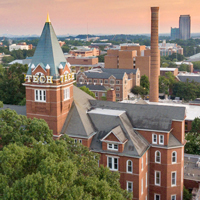
A view of Tech Tower from Crosland Tower. Photo: Georgia Tech

More than 30 College of Sciences faculty across all six schools and the Undergraduate Program in Neuroscience are recognized by the Institute for their excellence in research and teaching.

InVenture Prize 2024 Winners

Winner Lilypad Health disrupts invasive healthcare practices with an accessible alternative.
Experts In The News

In December, The Conversation hosted a webinar on AI’s revolutionary role in drug discovery and development. Science and technology editor Eric Smalley interviewed Jeffrey Skolnick, Regents' Professor and eminent scholar in computational systems biology at Georgia Institute of Technology, and Benjamin P. Brown, assistant professor of pharmacology at Vanderbilt University. Skolnick has developed AI-based approaches to predict protein structure and function that may help with drug discovery and finding off-label uses of existing drugs. Brown’s lab works on creating new computer models that make drug discovery faster and more reliable.

The Conversation April 7, 2026

While it often gets written off as being distracted or not paying attention, daydreaming is actually a sign of an active and imaginative mind. In fact, a 2017 study found that daydreamers are generally smarter than their focused peers. “People with efficient brains may have too much brain capacity to stop their minds from wandering,” said Eric Schumacher, the Georgia Tech psychology professor who co-authored the study.

People who daydream frequently have things running through their heads, whether they are thinking through ideas or picturing possible outcomes. Letting the mind wander allows unexpected connections to form. To an outside observer, they may seem checked out of reality. However, other highly intellectual people know that they're truly deeply engaged, just not with what's going on right in front of them.

Your Tango April 4, 2026

Upcoming Events

Apr
27
2026
AI is charging forward with unprecedented speed and impact.
Apr
28
2026
College of Sciences students, faculty, and staff are invited to our end-of-school year town hall.
May
01
2026
EAS 1600 students maintain the Library, and it's open to everyone on Fridays from 3:30 - 4:30 pm when classes are in session. Come learn about houseplants and bring your own plant home!

Spark: College of Sciences at Georgia Tech

Welcome — we're so glad you're here. Learn more about us in this video, narrated by Susan Lozier, College of Sciences Dean and Betsy Middleton and John Clark Sutherland Chair.