
College of Sciences

Latest News

The Trinity Demonstrator telescope. (Photo Nepomuk Otte)

Physics Professor Nepomuk Otte and students have developed the Trinity Demonstrator to search for sources of high-energy neutrinos that contain clues to the early universe.
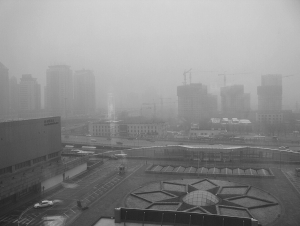


Beijing pollution (Photo Kevin Dooley, Creative Commons)

School of Earth and Atmospheric Sciences researchers find dangerous sulfates are formed, and their particles get bigger, within the plumes of pollution belching from coal-fired power plants.



health disparities.jpg

The advent of whole genome sequencing technology has prompted an explosion in research into how genetics are associated with disease risk. But the vast majority of genetics research has been done on people of European ancestry, and genetics researchers have realized that in order to address health disparities, more needs to be done.
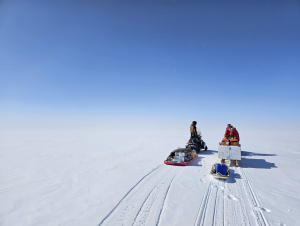
The team snowmobiling to a remote field site.

Rachel Moore is an expert at collecting data in difficult research environments, traveling to some of the most extreme places on Earth to research microbes and better understand astrobiology. This summer, she traveled to Greenland to collect ice cores, spending nearly 50 days on top of the Greenland Ice Sheet. The research could improve climate change predictions, while also helping astrobiologists better search for signs of life on icy worlds.

Tailgating on Tech Lawn

The senior director of the Georgia Tech Center for Mental Health Care and Resources gives tips for managing end-of-year stress.
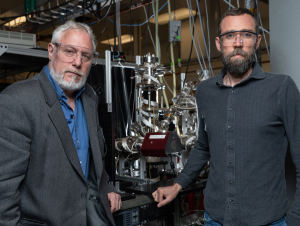
Thom Orlando (left) and Brant Jones

New Nature Astronomy research by Thom Orlando and Brant Jones shows electrons from Earth may contribute to the formation of water on the Moon’s surface. The work may impact our understanding of how water — a critical resource for life and sustained future human missions to the Moon — formed and continues to evolve on the lunar surface.
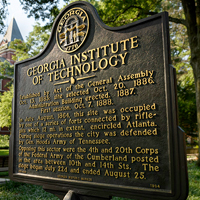
Experts In The News

In December, The Conversation hosted a webinar on AI’s revolutionary role in drug discovery and development. Science and technology editor Eric Smalley interviewed Jeffrey Skolnick, Regents' Professor and eminent scholar in computational systems biology at Georgia Institute of Technology, and Benjamin P. Brown, assistant professor of pharmacology at Vanderbilt University. Skolnick has developed AI-based approaches to predict protein structure and function that may help with drug discovery and finding off-label uses of existing drugs. Brown’s lab works on creating new computer models that make drug discovery faster and more reliable.

The Conversation April 7, 2026

While it often gets written off as being distracted or not paying attention, daydreaming is actually a sign of an active and imaginative mind. In fact, a 2017 study found that daydreamers are generally smarter than their focused peers. “People with efficient brains may have too much brain capacity to stop their minds from wandering,” said Eric Schumacher, the Georgia Tech psychology professor who co-authored the study.

People who daydream frequently have things running through their heads, whether they are thinking through ideas or picturing possible outcomes. Letting the mind wander allows unexpected connections to form. To an outside observer, they may seem checked out of reality. However, other highly intellectual people know that they're truly deeply engaged, just not with what's going on right in front of them.

Your Tango April 4, 2026

Upcoming Events

Apr
28
2026
College of Sciences students, faculty, and staff are invited to our end-of-school year town hall.
May
01
2026
EAS 1600 students maintain the Library, and it's open to everyone on Fridays from 3:30 - 4:30 pm when classes are in session. Come learn about houseplants and bring your own plant home!

Spark: College of Sciences at Georgia Tech

Welcome — we're so glad you're here. Learn more about us in this video, narrated by Susan Lozier, College of Sciences Dean and Betsy Middleton and John Clark Sutherland Chair.