College of Sciences

Latest News

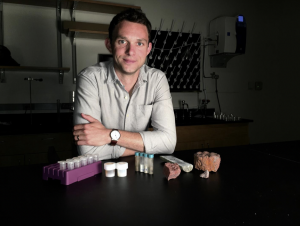
Chris Reinhard .png

Newly appointed Georgia Power Chair Chris Reinhard, an associate professor in the School of Earth and Atmospheric Sciences, will co-lead a $4.8 million USDA pilot project, studying a process that could help farms trap atmospheric carbon while providing more nutrients for crops.
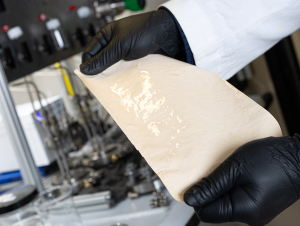
 

Crude Oil DUCKY Membrane

The membranes would improve distillation processes that account for 1% of the world’s energy use.
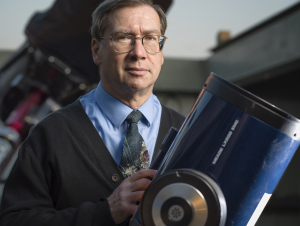
Jim Sowell

Jim Sowell talks about Georgia Tech's observatory, what can be learned from an eclipse, and why you should watch for it wherever you are.
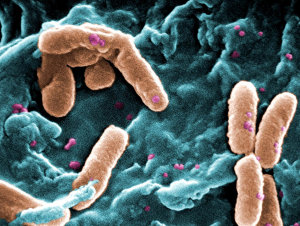
Electron microscope image of bacteria (Photo Janice Carr Wikimedia Commons).jpeg

Georgia Tech’s Center for Microbial Dynamics and Infection receives nearly $1.5 million in grants to study bacterial defenses and communications — how they use them to join multicellular groups while protecting themselves from threats, and how they use ‘quorum sensing’ to take collective action.
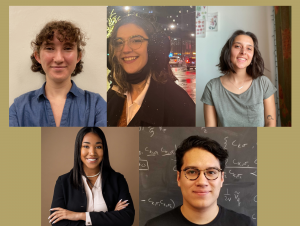


UCEM Fellows (clockwise from top left) Sarah E. Gonzalez, Danielle Grau, Sierra Knavel, Tony Lemos, Autumn Peterson.png

With goals to boost science, engineering, and computing Ph.D. researchers from underserved populations, UCEM grows in 2023 to include students from Schools of Biological Sciences, Earth and Atmospheric Sciences, Mathematics, and Physics.
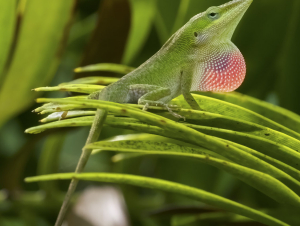


lizard-evolution-feature-thumb.jpg

By lassoing lizards, putting tiny chips on their legs, and tracking them for three years, Georgia Tech’s James Stroud revealed why species often appear unchanged for millions of years despite Charles Darwin’s theory of constant evolution.
Experts In The News

In December, The Conversation hosted a webinar on AI’s revolutionary role in drug discovery and development. Science and technology editor Eric Smalley interviewed Jeffrey Skolnick, Regents' Professor and eminent scholar in computational systems biology at Georgia Institute of Technology, and Benjamin P. Brown, assistant professor of pharmacology at Vanderbilt University. Skolnick has developed AI-based approaches to predict protein structure and function that may help with drug discovery and finding off-label uses of existing drugs. Brown’s lab works on creating new computer models that make drug discovery faster and more reliable.

The Conversation April 7, 2026

While it often gets written off as being distracted or not paying attention, daydreaming is actually a sign of an active and imaginative mind. In fact, a 2017 study found that daydreamers are generally smarter than their focused peers. “People with efficient brains may have too much brain capacity to stop their minds from wandering,” said Eric Schumacher, the Georgia Tech psychology professor who co-authored the study.

People who daydream frequently have things running through their heads, whether they are thinking through ideas or picturing possible outcomes. Letting the mind wander allows unexpected connections to form. To an outside observer, they may seem checked out of reality. However, other highly intellectual people know that they're truly deeply engaged, just not with what's going on right in front of them.

Your Tango April 4, 2026

Upcoming Events

Apr
28
2026
College of Sciences students, faculty, and staff are invited to our end-of-school year town hall.
May
01
2026
EAS 1600 students maintain the Library, and it's open to everyone on Fridays from 3:30 - 4:30 pm when classes are in session. Come learn about houseplants and bring your own plant home!

Spark: College of Sciences at Georgia Tech

Welcome — we're so glad you're here. Learn more about us in this video, narrated by Susan Lozier, College of Sciences Dean and Betsy Middleton and John Clark Sutherland Chair.