
College of Sciences

Latest News

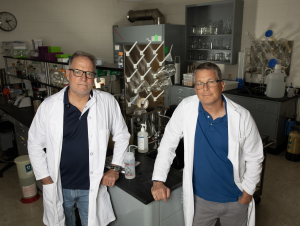
Researchers Michael Farrell (left) and Brian Hammer are working on a potential new way to boost the effectiveness of influenza vaccines. (Credit: Sean McNeil)

A newly funded research project might one day lead to the development of a pill or capsule able to boost the effectiveness of traditional vaccines against influenza, which kills as many as 52,000 people and leads to hundreds of thousands of hospitalizations a year in the United States.

audiomoth

Scientists at the Georgia Institute of Technology and Max Planck Institute for Intelligent Systems in Stuttgart have published a perspectives piece on the different tools used throughout the world aiding in the conservation of wildlife and biodiversity.

Three noticeable out-of-plane microtubule bundles are misaligned with the rest of the microtubules at the bottom left of the image.

Physicists have developed a new model and clearer picture of molecular movements within active matter — bringing science a step closer to designing specific functions into new materials, and understanding emergent behaviors.

Kaolinite from Twiggs Co., GA (Photo Wikimedia Commons).jpeg

Rare earth elements are critical to technology, electronics, and rapidly evolving clean energy efforts. Equipped with a new NSF grant, Yuanzhi Tang is helping find and unlock these key minerals in Georgia kaolin deposits.
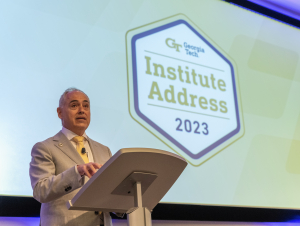


President Ángel Cabrera delivers the 2023 Institute Address.

President Ángel Cabrera highlighted Georgia Tech’s record-breaking year.  

2023-BBISS-Grad-Fellows-Montage.jpg

The Brook Byers Institute for Sustainable Systems (BBISS) Graduate Fellows Program provides graduate students with enhanced training in sustainability, team science, and leadership in addition to their usual programs of study.
Experts In The News

In December, The Conversation hosted a webinar on AI’s revolutionary role in drug discovery and development. Science and technology editor Eric Smalley interviewed Jeffrey Skolnick, Regents' Professor and eminent scholar in computational systems biology at Georgia Institute of Technology, and Benjamin P. Brown, assistant professor of pharmacology at Vanderbilt University. Skolnick has developed AI-based approaches to predict protein structure and function that may help with drug discovery and finding off-label uses of existing drugs. Brown’s lab works on creating new computer models that make drug discovery faster and more reliable.

The Conversation April 7, 2026

While it often gets written off as being distracted or not paying attention, daydreaming is actually a sign of an active and imaginative mind. In fact, a 2017 study found that daydreamers are generally smarter than their focused peers. “People with efficient brains may have too much brain capacity to stop their minds from wandering,” said Eric Schumacher, the Georgia Tech psychology professor who co-authored the study.

People who daydream frequently have things running through their heads, whether they are thinking through ideas or picturing possible outcomes. Letting the mind wander allows unexpected connections to form. To an outside observer, they may seem checked out of reality. However, other highly intellectual people know that they're truly deeply engaged, just not with what's going on right in front of them.

Your Tango April 4, 2026

Upcoming Events

May
01
2026
EAS 1600 students maintain the Library, and it's open to everyone on Fridays from 3:30 - 4:30 pm when classes are in session. Come learn about houseplants and bring your own plant home!

Spark: College of Sciences at Georgia Tech

Welcome — we're so glad you're here. Learn more about us in this video, narrated by Susan Lozier, College of Sciences Dean and Betsy Middleton and John Clark Sutherland Chair.