
College of Sciences

Latest News

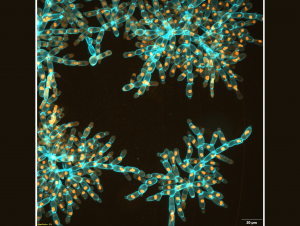
Macroscopic snowflake yeast with elongated cells fracture into modules, retaining the same underlying branched growth form of their microscopic ancestor.

To investigate how multicellular life evolves from scratch, researchers from the Georgia Institute of Technology decided to take evolution into their own hands. Led by William Ratcliff, associate professor in the School of Biological Sciences and director of the Interdisciplinary Graduate Program in Quantitative Biosciences, a team of researchers has initiated the first long-term evolution experiment aimed at evolving new kinds of multicellular organisms from single-celled ancestors in the lab.

NSF Graduate Research Fellowship Program

Following in the early footsteps of esteemed Nobel laureates, national leaders, and esteemed faculty, 38 of Tech’s graduate students have just been awarded the National Science Foundation Graduate Research Fellowship (NSF GRF). 

Georgia Tech takes pride in reading aloud the name of each graduate as they receive their diploma. Photo taken May 5 by Joya Chapman.

Georgia Tech's 264th Commencement, held May 5 and 6 at Bobby Dodd Stadium, celebrated 5,673 graduates. Here are a few moments captured during the event. More images from Spring Commencement are available on Flickr.
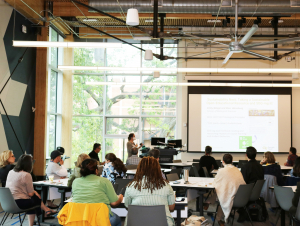
Georgia Tech researchers give presentations on their Undergraduate Sustainability Education Innovation Grants during a recent "Jamboree" in the Kendeda Building. (Photo Jess Hunt-Ralston)

Six proposals from the College of Sciences will evolve existing courses, create new ones to include the United Nations Sustainable Development Goals — a key part of Georgia Tech’s Sustainability Next initiative.
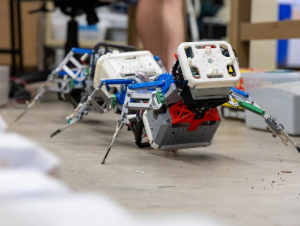


Centipedes are known for their wiggly walk. With tens to hundreds of legs, they can traverse any terrain without stopping.

Intrigued to see if the many limbs could be helpful for locomotion in this world, a team of physicists, engineers, and mathematicians at the Georgia Institute of Technology are using this style of movement to their advantage. They developed a new theory of multilegged locomotion and created many-legged robotic models, discovering the robot with redundant legs could move across uneven surfaces without any additional sensing or control technology as the theory predicted.
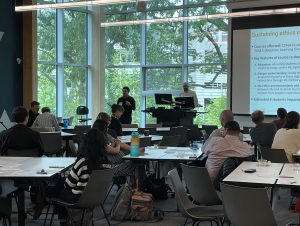
Borelo Jamboree

One of the Institute Strategic Plan (ISP) goals is to connect globally and amplify impact by contributing “to global collaborative efforts that advance the U.N. Sustainable Development Goals (SDGs) through our education, research, and service.” In response, Sustainability Next developed a plan to expand SDG concept and skill integration across the undergraduate curriculum. In support of the plan, 21 projects representing all six colleges and 15 schools were presented at the Undergraduate Sustainability Education Jamboree, held on April 26 in the Kendeda Building auditorium. With many winning projects featuring high enrollment and core courses, this first round of sustainability education “seed grants” will significantly expand the reach of Georgia Tech’s sustainability-across-the-curriculum initiatives.
Experts In The News

In December, The Conversation hosted a webinar on AI’s revolutionary role in drug discovery and development. Science and technology editor Eric Smalley interviewed Jeffrey Skolnick, Regents' Professor and eminent scholar in computational systems biology at Georgia Institute of Technology, and Benjamin P. Brown, assistant professor of pharmacology at Vanderbilt University. Skolnick has developed AI-based approaches to predict protein structure and function that may help with drug discovery and finding off-label uses of existing drugs. Brown’s lab works on creating new computer models that make drug discovery faster and more reliable.

The Conversation April 7, 2026

While it often gets written off as being distracted or not paying attention, daydreaming is actually a sign of an active and imaginative mind. In fact, a 2017 study found that daydreamers are generally smarter than their focused peers. “People with efficient brains may have too much brain capacity to stop their minds from wandering,” said Eric Schumacher, the Georgia Tech psychology professor who co-authored the study.

People who daydream frequently have things running through their heads, whether they are thinking through ideas or picturing possible outcomes. Letting the mind wander allows unexpected connections to form. To an outside observer, they may seem checked out of reality. However, other highly intellectual people know that they're truly deeply engaged, just not with what's going on right in front of them.

Your Tango April 4, 2026

Upcoming Events

May
01
2026
EAS 1600 students maintain the Library, and it's open to everyone on Fridays from 3:30 - 4:30 pm when classes are in session. Come learn about houseplants and bring your own plant home!

Spark: College of Sciences at Georgia Tech

Welcome — we're so glad you're here. Learn more about us in this video, narrated by Susan Lozier, College of Sciences Dean and Betsy Middleton and John Clark Sutherland Chair.