College of Sciences

Latest News

Mosaic Turbulence

Blumenthal, an assistant professor in the School of Mathematics, has been awarded an NSF CAREER grant continue tackling some of the most difficult questions in his field– those of chaotic fluid dynamics. Because Blumenthal’s work with fluid dynamics intersects with chaos and disorder, the impacts of his work range from weather prediction to how we model economics.
 

Chemistry Mosaic

School of Chemistry and Biochemistry's Jesse McDaniel is creating a framework to predict chemical reaction rates, leveraging computer modeling techniques. Now, a new NSF CAREER grant will help him do so. “I am excited about the CAREER research because we are really focusing on fundamental questions that are central to all of chemistry,” McDaniel says about the project.
Petri Dish Mosaic

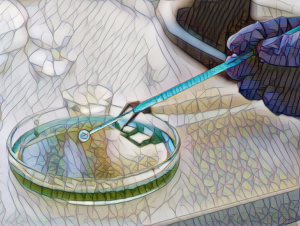
Agarwal’s award specifically focuses on his research into peptides, short strings of amino acids that make up proteins. “We’re making new types of peptides and modified peptides,” Agarwal explains. “Modifications in a lot of antibiotics that we use are actually peptides.”
 

Mosaic Network

Anton Bernshteyn is forging connections and creating a language to help computer scientists and mathematicians collaborate on new problems — in particular, bridging the gap between solvable, finite problems and more challenging, infinite problems. Now, an NSF CAREER grant will help him achieve that goal.
Boldenwithcoral.jpeg

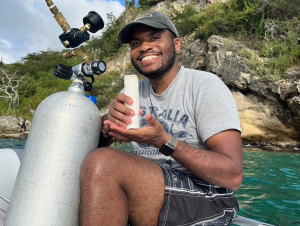
On the U.S. Virgin Island of St. Croix, the ruins of a Danish sugar plantation built from harvested coral bricks could be the key to understanding how and why the area was decimated by the 18th-century transatlantic slave trade. With funding from the National Geographic Society, researchers at the Georgia Institute of Technology and the University of California, Los Angeles (UCLA) will travel to St. Croix to analyze this coral. They hope to determine how coral mining, dredging, and reef erosion affected near-shore biodiversity, contemporary coral populations, and bathymetry or underwater depth. The project uniquely combines archeology and oceanography.
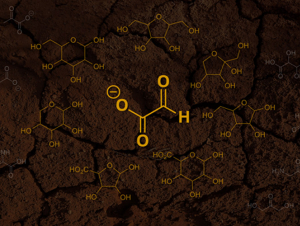
A new hypothesis states that the first sugars emerged from glyoxylate (pictured as the center molecule). In this hypothesis, glyoxylate first reacts with itself and then the byproducts from these reactions. Credit: Scripps Research and Unsplash

Origin-of-life chemists from Scripps Research and the Georgia Institute of Technology propose that glyoxylate could have been the original source of sugars on the “prebiotic” Earth.
Experts In The News

In December, The Conversation hosted a webinar on AI’s revolutionary role in drug discovery and development. Science and technology editor Eric Smalley interviewed Jeffrey Skolnick, Regents' Professor and eminent scholar in computational systems biology at Georgia Institute of Technology, and Benjamin P. Brown, assistant professor of pharmacology at Vanderbilt University. Skolnick has developed AI-based approaches to predict protein structure and function that may help with drug discovery and finding off-label uses of existing drugs. Brown’s lab works on creating new computer models that make drug discovery faster and more reliable.

The Conversation April 7, 2026

While it often gets written off as being distracted or not paying attention, daydreaming is actually a sign of an active and imaginative mind. In fact, a 2017 study found that daydreamers are generally smarter than their focused peers. “People with efficient brains may have too much brain capacity to stop their minds from wandering,” said Eric Schumacher, the Georgia Tech psychology professor who co-authored the study.

People who daydream frequently have things running through their heads, whether they are thinking through ideas or picturing possible outcomes. Letting the mind wander allows unexpected connections to form. To an outside observer, they may seem checked out of reality. However, other highly intellectual people know that they're truly deeply engaged, just not with what's going on right in front of them.

Your Tango April 4, 2026

Upcoming Events

May
01
2026
EAS 1600 students maintain the Library, and it's open to everyone on Fridays from 3:30 - 4:30 pm when classes are in session. Come learn about houseplants and bring your own plant home!

Spark: College of Sciences at Georgia Tech

Welcome — we're so glad you're here. Learn more about us in this video, narrated by Susan Lozier, College of Sciences Dean and Betsy Middleton and John Clark Sutherland Chair.