College of Sciences

Latest News

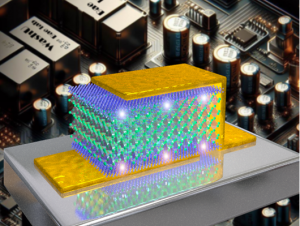
The team is using a precise layer splitting technique to overcome drawbacks in ferroelectric materials use in electrostatic capacitors.

Three researchers in a joint international research laboratory based at Georgia Tech-Europe in Metz, France, are among a team demonstrating cutting-edge single-crystalline integration — using a precise layer splitting technique to overcome material drawbacks.
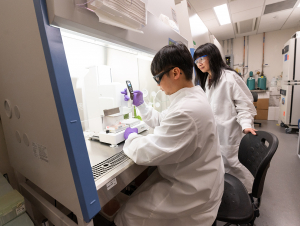
Researchers in Nga Lee (Sally) Ng's lab

Their awards total more than $9.5 million in funding, the most Georgia Tech has ever had in the program.
Postdoc Community

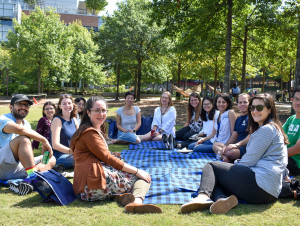
We asked our postdocs whom they would like to extend their thanks. Their responses revealed the profound impact of collaboration, mentorship, and peer support. 
Hope Hazelton

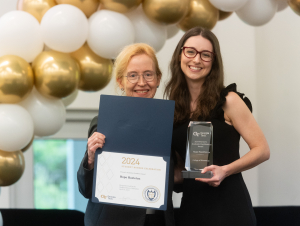
Students from all six College of Sciences schools were recognized for excellence at this year's celebration.

Photo credit: Paul Skorupskas, unsplash.com

A team of Georgia Tech researchers is the first to study the relationship between fluctuations in attention and the brain network patterns within low-frequency 20-second cycles. They found that synchronized and desynchronized activity in different brain networks across 20-second cycles corresponds to small shifts in attention levels. The research may have applications for therapeutic treatments and could be a springboard for future innovation.
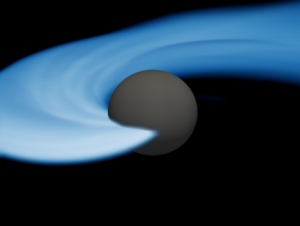
The coalescence and merger of a lower mass-gap black hole (dark gray surface) with a neutron star (greatly tidally deformed by the black hole's gravity). Credit: Ivan Markin, Tim Dietrich (University of Potsdam), Harald Paul Pfeiffer, Alessandra Buonanno

Shortly after the start of the fourth LIGO-Virgo-KAGRA (LVK) observing run, the LIGO Livingston detector observed a remarkable gravitational-wave signal from the collision of what is most likely a neutron star with an unknown compact object — one that's 2.5 to 4.5 times the mass of the Sun.
Experts In The News

Alex Robel, an associate professor in the School of Earth and Atmospheric Sciences at Georgia Tech, said pumping sand onshore is far from a perfect solution to stabilize a beach, but it’s “one of the best tools we have in our arsenal.”

“It’s been done in the United States for almost a century in different places and we know how to do it,” Robel said. “We’re good at it.”

But nourishment is only a Band-Aid for erosion. Once cities start replenishing sand, Robel said they have to keep doing it regularly. 

Atlanta Journal Constitution March 24, 2026

A team of researchers including David Hu, a professor in Georgia Tech’s School of Biological Sciences and George W. Woodruff School of Mechanical Engineering, have visualized mosquito flight behavior for the first time.

Based on their data, the researchers said they don’t think mosquitoes swarm because they’re following the pack. Each appeared to pick up on the cues independently, then found themselves at the same place at the same time.

“It’s like a crowded bar,” said Hu. “Customers aren’t there because they followed each other into the bar. They’re attracted by the same cues: drinks, music, and the atmosphere. The same is true of mosquitoes. Rather than following the leader, the insect follows the signals and happens to arrive at the same spot as the others. They’re good copies of each other.”

A similar story was published by The Economic Times.

ScienceDaily March 22, 2026

Upcoming Events

Apr
10
2026
Join the Spatial Ecology and Paleontology Lab for Fossil Fridays! Become a fossil hunter and help discover how vertebrate communities have changed through time.
Apr
10
2026
EAS 1600 students maintain the Library, and it's open to everyone on Fridays from 3:30 - 4:30 pm when classes are in session. Come learn about houseplants and bring your own plant home!
Apr
15
2026
Apr
16
2026
Join us for an afternoon of demonstrations on how AI can be used in research.
Apr
17
2026
This comprehensive hands-on workshop will guide participants through building a Mortgage Assistant Agent.

Spark: College of Sciences at Georgia Tech

Welcome — we're so glad you're here. Learn more about us in this video, narrated by Susan Lozier, College of Sciences Dean and Betsy Middleton and John Clark Sutherland Chair.