Latest News

A team of Georgia Tech researchers is the first to study the relationship between fluctuations in attention and the brain network patterns within low-frequency 20-second cycles. They found that synchronized and desynchronized activity in different brain networks across 20-second cycles corresponds to small shifts in attention levels. The research may have applications for therapeutic treatments and could be a springboard for future innovation.
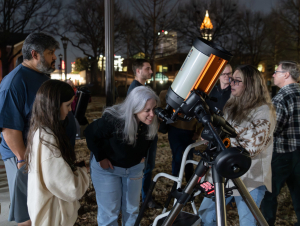
This week, 50 students from Georgia Tech’s Astronomy Club will travel to Missouri to view the solar eclipse on April 8. Georgia isn’t in the path of totality — which occurs when the moon fully covers the sun — but Missouri is, and club members want to be there to experience the rare celestial event. While viewing the eclipse is the organization’s biggest adventure of the year, it is just one of many events the club hosts every month. The group is a place for hobbyist astronomers and physics students to connect over their love of the solar system and the mysteries within it.

As the April 8 solar eclipse approaches, millions of people anticipate participating in the wonder of this celestial event. Yet, for those with visual impairments, traditional methods of observing such phenomena may present limitations. Fortunately, resources from the team of Tech’s Sonification Lab offer an inclusive approach.

Sparked by a professor’s interest, 55 students from the School of Physics will travel to Illinois to enter the path of totality for the April 8 total solar eclipse.
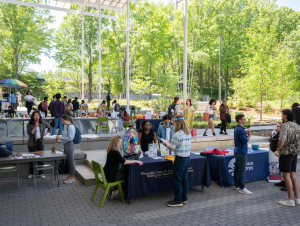
April is Earth Month with a full calendar of events open to the campus community.

Scientists at Georgia Tech have teamed up with the University of Southern California (USC), University of Pennsylvania, Texas A&M, Oregon State, Temple University, and NASA Johnson Space Center to teach dog-like robots to navigate craters of the Moon and other challenging planetary surfaces in research funded by NASA.