College of Sciences

Latest News

Iyer completed much of her research while in high school and submitted the paper for publication as a Georgia Tech first-year.

Second-year biology student Anu Iyer’s groundbreaking research is revolutionizing Parkinson’s disease detection. Through a three-second phone call, her team’s machine-learning model can detect Parkinson’s with 97 percent accuracy. 

TechTower.jpg

Georgia Tech achieved a record $5.3 billion economic impact in 2023, the highest in the state of Georgia. The university has driven significant economic growth, accounting for 24% of the University System of Georgia’s total impact and 42% of its economic growth since 2019. Additionally, Georgia Tech leads in employment impact, supporting 34,000 jobs across the state.

Students Diya Godavarti and Waynell Simbafo with Chemistry faculty Pamela Pollet

A Georgia Tech team placed second in the statewide Vertical Integrated Project Innovation competition for a poster modeling chemical exposure and socioeconomic disparities.

Felix Herrmann

By encouraging joint appointments, the Institute breaks down traditional academic silos and enables researchers to revolutionize the energy landscape.

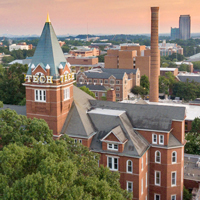
Tech Tower and Atlanta Skyline

College of Sciences faculty are among the recipients of the third round of Undergraduate Sustainability Education Innovation Grants awarded by the Center for Teaching and Learning.

thumbnail-energy-joint-appointment.jpg

By encouraging joint appointments, the Institute breaks down traditional academic silos and enables researchers to revolutionize the energy landscape.

Experts In The News

Green iguanas (Iguana iguana) are not native to the U.S. but were brought to Florida in the 1960s, where they have, for the most part, flourished—except, that is, when temperatures have dropped below 50 degrees F (10 degrees C). 

These chilly conditions can cause a cold shock in the lizards. And because the iguanas tend to sleep in trees, getting cold shocked can sometimes cause the animals to fall from the skies in an infamous Florida phenomenon. 

“These tropical lizards were experiencing conditions that they’ve never experienced in their entire evolutionary history before, tens of millions of years,” says James Stroud, an evolutionary biologist at the Georgia Institute of Technology.

But in Florida, colder conditions occur every few years—albeit less often as temperatures rise because of climate change. The experience of the iguanas that have been forced to confront the cold in the state can teach scientists more about how animals respond to new climates more generally, Stroud says.

Scientific American January 16, 2026

Jennifer Glass, professor in the School of Earth and Atmospheric Sciences, was recently quoted in an article published in Scientific American that discusses the evolution of Wikipedia:

As Wikipedia’s use grew, some educators softened their stance, encouraging its use to find leads to sources that students could dig into directly. Others took a different approach, assigning students to edit Wikipedia entries—many through Wiki Education.

Jennifer Glass, a biogeochemist at Georgia Institute of Technology, is one of those professors; she has incorporated Wikipedia editing into her teaching since 2018. She wanted a student project that emphasized the concise and technical but understandable writing style that the site uses. And although she hadn’t done much editing for Wikipedia herself, she was impressed by the website’s breadth of content.

Each semester, her students write one article from scratch about a topic they research, from dolomitization to the tropopause. Glass says the project teaches them the value of institutional access to published literature and the skill of fact-checking their writing line by line.

Scientific American January 15, 2026

Upcoming Events

Feb
13 to 20
2026
Feb
18
2026
Featuring | Ganesh Sundaramoorthi - Senior Research Fellow/Director of Research at RTX Technology Research Center
Feb
19
2026
Leaders and trainees across academia, research, and clinical practice to share their experiences and offer guidance for undergraduate students exploring future careers.
Feb
20
2026
Join the Spatial Ecology and Paleontology Lab for Fossil Fridays! Become a fossil hunter and help discover how vertebrate communities have changed through time.
Feb
20
2026
EAS 1600 students maintain the Library, and it's open to everyone on Fridays from 3:30 - 4:30 pm when classes are in session. Come learn about houseplants and bring your own plant home!

Spark: College of Sciences at Georgia Tech

Welcome — we're so glad you're here. Learn more about us in this video, narrated by Susan Lozier, College of Sciences Dean and Betsy Middleton and John Clark Sutherland Chair.