College of Sciences

Latest News

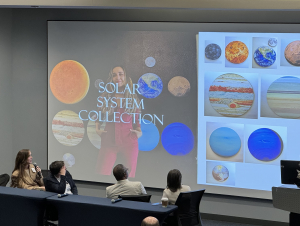
John Wise, left, speaks at the 2024 Asimov Debate

Wise, a professor in the School of Physics and director of the Center for Relativistic Astrophysics, spoke to how the James Webb Space Telescope has impacted astrophysics and our understanding of the formation of galaxies and black holes — a research area he specializes in at Georgia Tech.

The LASSIE Project’s robot, dubbed Spirit, can “feel” and interpret surface force responses via leg-terrain interactions, assisting planetary scientists with data collection at Oregon’s Mount Hood, a lunar-analog site. (Justin Durner/LASSIE Project)

Scientists at Georgia Tech have teamed up with the University of Southern California (USC), University of Pennsylvania, Texas A&M, Oregon State, Temple University, and NASA Johnson Space Center to teach dog-like robots to navigate craters of the Moon and other challenging planetary surfaces in research funded by NASA.

Georgia Tech students witness the 2017 total solar eclipse on campus.

While outside of the path of totality, the Georgia Tech community can still take part in the historic April total solar eclipse.  

13C5438-P1-040-Web Use - 1,000px Wide.jpg

Georgia Tech is supporting career growth for its research faculty, who do critical work at the heart of the research enterprise.

Chunhui (Rita) Du

Chunhui (Rita) Du has been awarded a $652,965 grant by the U.S. Department of Energy for her research into quantum sensing. “The project has the potential to make important contributions to the burgeoning field of quantum materials,” says Du, “and to significantly promote the role of topological magnets in developing next-generation, transformative information technologies.”

AI Magazine 2024 Volume 45 Issue 1 Cover.png

The AAAI's Spring 2024 Special Issue of AI Magazine, titled "Beneficial AI," showcases research, applications, and education initiatives led by NSF and USDA-NIFA-funded AI Research Institutes, including insights from Georgia Tech's AI-ALOE, AI4OPT, and AI-CARING, highlighting their contributions to AI for societal good and future impact.

Experts In The News

Can Alzheimer’s disease be slowed by flickering lights and sound?

That is the question that drives Annabelle Singer, a McCamish Foundation Early Career Professor in the Wallace H. Wallace H. Coulter Department of Biomedical Engineering at Georgia Tech and Emory University. In her lab on Tech’s campus in Atlanta, Singer is trying to better understand patterns of neural activity in the brain and what goes wrong with Alzheimer’s patients. Building on that knowledge, she hopes to develop new ways to treat the disease.

“We are taking a really different approach to Alzheimer’s,” she said. “We’ve determined how neural activity that is essential for memory fails in Alzheimer’s disease. We’re then using that information to develop brain stimulation that could improve brain health.”

CNN February 16, 2026

Until now, no one had built a synthetic material that could simultaneously absorb chemical building blocks, polymerize them into its own network, relieve the mechanical stresses that accumulate during the process, and reverse the whole sequence on demand. A new study published in Advanced Materials ("Rewriting Polymer Fate via Chemomechanical Coupling") reports a polymer platform that accomplishes exactly that. A team at the Georgia Institute of Technology including Associate Professor Will Gutekunst of the School of Chemistry and Biochemistry, with collaborators at North Carolina State University, created what they call a "living" polymer: a material that can grow, shrink, heal, change its stiffness by roughly 100-fold, and be recycled back to raw monomers, all post-fabrication.

Nanowerk News February 12, 2026

Upcoming Events

Feb
13 to 20
2026
Feb
18
2026
Featuring | Ganesh Sundaramoorthi - Senior Research Fellow/Director of Research at RTX Technology Research Center
Feb
19
2026
Leaders and trainees across academia, research, and clinical practice to share their experiences and offer guidance for undergraduate students exploring future careers.
Feb
20
2026
Join the Spatial Ecology and Paleontology Lab for Fossil Fridays! Become a fossil hunter and help discover how vertebrate communities have changed through time.
Feb
20
2026
EAS 1600 students maintain the Library, and it's open to everyone on Fridays from 3:30 - 4:30 pm when classes are in session. Come learn about houseplants and bring your own plant home!

Spark: College of Sciences at Georgia Tech

Welcome — we're so glad you're here. Learn more about us in this video, narrated by Susan Lozier, College of Sciences Dean and Betsy Middleton and John Clark Sutherland Chair.