To request a media interview, please reach out to experts using the faculty directories for each of our six schools, or contact Jess Hunt-Ralston, College of Sciences communications director. A list of faculty experts is also available to journalists upon request.
News Center
Latest News

Susan Lozier, dean and Betsy Middleton and John Clark Sutherland Chair of the College of Sciences, will serve a three-year term on the inaugural Climate Security Roundtable, a joint initiative across the U.S. Congress and the National Academies.

A Topology and Geometry conference run completely by graduate students took place in April at GT.

Georgia Tech is among a collaborative team of institutions awarded a $5 million OpenCI grant from the National Science Foundation (NSF) to help support the Advanced Cyberinfrastructure Coordination Ecosystem Services and Support (ACCESS) program.
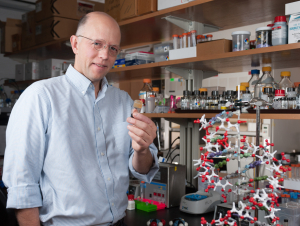
With support from the Sloan Foundation, the team hopes to create novel chemical systems that harness the power of evolution.

Samer Naif, assistant professor in the School of Earth and Atmospheric Sciences, co-authors a Scripps Institution of Oceanography study showing streams of heated rocks called mantle plumes probably play a role in creating a slippery base for tectonic plates.

The rising sea levels along Georgia’s Savannah coast and an uptick in more severe storms during hurricane season are bellwethers to looming ecological challenges stemming from climate change.
Experts In The News
Alex Robel, an associate professor in the School of Earth and Atmospheric Sciences at Georgia Tech, said pumping sand onshore is far from a perfect solution to stabilize a beach, but it’s “one of the best tools we have in our arsenal.”
“It’s been done in the United States for almost a century in different places and we know how to do it,” Robel said. “We’re good at it.”
But nourishment is only a Band-Aid for erosion. Once cities start replenishing sand, Robel said they have to keep doing it regularly.
Atlanta Journal Constitution March 24, 2026A team of researchers including David Hu, a professor in Georgia Tech’s School of Biological Sciences and George W. Woodruff School of Mechanical Engineering, have visualized mosquito flight behavior for the first time.
Based on their data, the researchers said they don’t think mosquitoes swarm because they’re following the pack. Each appeared to pick up on the cues independently, then found themselves at the same place at the same time.
“It’s like a crowded bar,” said Hu. “Customers aren’t there because they followed each other into the bar. They’re attracted by the same cues: drinks, music, and the atmosphere. The same is true of mosquitoes. Rather than following the leader, the insect follows the signals and happens to arrive at the same spot as the others. They’re good copies of each other.”
A similar story was published by The Economic Times.
ScienceDaily March 22, 2026