To request a media interview, please reach out to experts using the faculty directories for each of our six schools, or contact Jess Hunt-Ralston, College of Sciences communications director. A list of faculty experts is also available to journalists upon request.
News Center
Latest News

It was a necessary skill for early humans: how to make tools out of rocks. It's a demanding skill to learn, yet it's helping Georgia Tech researchers fill in the gaps when it comes to the science of how we learn complex motor skills — and what may be required to relearn them.
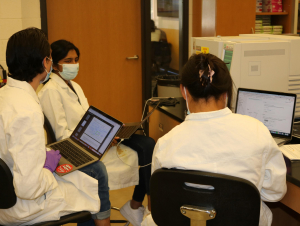
Equipment purchased with Tech Fees make a huge difference in putting sophisticated instrumentation into Georgia Tech's teaching labs, say College of Sciences administrators, giving undergraduates experiences that are beyond those typically found at other institutions of higher learning.
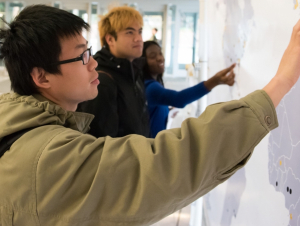
During International Education Week, the College of Sciences celebrates the impact of international perspectives, connection, and contributions in our community.

A recent study from the School of Psychology puts a spotlight on how leadership opportunities in early careers can affect workers, with gender differences apparent and implications for the current pandemic-related "Great Resignation" trend in U.S. workplaces.

One of Georgia Tech’s core values, “We act ethically,” guides our priorities every day. Explore 2021 Ethics Week events, including an interdisciplinary panel of faculty in biological sciences, civil and environmental engineering, business, and public policy discussing teaching ethics and preparing students for ethical dilemmas in their careers.
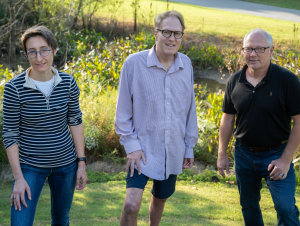
Found at the boundary between land and water, wetlands function as natural sponges that trap, cleanse, and slowly release surface water – they also serve as a natural climate change buffer, since they act as carbon “sinks,” storing vast amounts of carbon and methane in the ground. Swamps, marshes, and bogs are all examples of wetlands. What isn’t known is if wetlands that become damaged or degraded from excess water will still absorb carbon at the same level. By better understanding how wetlands work, Georgia Tech hopes to shed light on how wetlands will function with more frequent and more intense rainstorms.
Experts In The News
Alex Robel, an associate professor in the School of Earth and Atmospheric Sciences at Georgia Tech, said pumping sand onshore is far from a perfect solution to stabilize a beach, but it’s “one of the best tools we have in our arsenal.”
“It’s been done in the United States for almost a century in different places and we know how to do it,” Robel said. “We’re good at it.”
But nourishment is only a Band-Aid for erosion. Once cities start replenishing sand, Robel said they have to keep doing it regularly.
Atlanta Journal Constitution March 24, 2026A team of researchers including David Hu, a professor in Georgia Tech’s School of Biological Sciences and George W. Woodruff School of Mechanical Engineering, have visualized mosquito flight behavior for the first time.
Based on their data, the researchers said they don’t think mosquitoes swarm because they’re following the pack. Each appeared to pick up on the cues independently, then found themselves at the same place at the same time.
“It’s like a crowded bar,” said Hu. “Customers aren’t there because they followed each other into the bar. They’re attracted by the same cues: drinks, music, and the atmosphere. The same is true of mosquitoes. Rather than following the leader, the insect follows the signals and happens to arrive at the same spot as the others. They’re good copies of each other.”
A similar story was published by The Economic Times.
ScienceDaily March 22, 2026