To request a media interview, please reach out to experts using the faculty directories for each of our six schools, or contact Jess Hunt-Ralston, College of Sciences communications director. A list of faculty experts is also available to journalists upon request.
News Center
Latest News

Watson, who is graduating with dual degrees in biology and industrial engineering, plus dual minors in social justice and physiology, shares six years of adventures at Tech and exploring the intersections between biology, engineering, health and wellness, and outer space.

Zulfiqar, who is graduating with a degree in psychology with the research option, discusses life at Georgia Tech — as a transfer student and the first woman in her family to graduate from college.
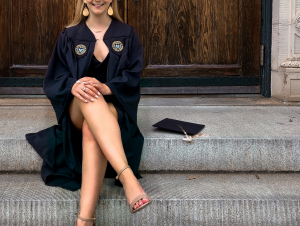
Kilpatrick, who is graduating with a degree in psychology and minor in health and medical sciences, shares that her path to a top-rated physician assistant program has been all about balancing academics and her own health — plus a lot of fun memories working with Georgia Tech Football as head student athletic trainer.

Inspired by a theoretical model of particles moving around on a chessboard, new robot swarm research led by Georgia Tech shows that, as magnetic interactions increase, dispersed “dumb robots” can abruptly gather in large, compact clusters to accomplish complex tasks. Researchers report that these “BOBbots” (behaving, organizing, buzzing bots) are also capable of collectively clearing debris that is too heavy for one alone to move, thanks to a robust algorithm.

The world's oceans are made up of various "ecoregions," but experts have had trouble connecting them. A new look at existing satellite data by researchers from the School of Earth and Atmospheric Sciences could provide a new way to link those regions, which may help scientists protect endangered marine species.
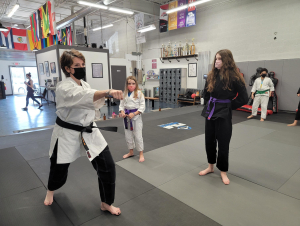
School of Chemistry and Biochemistry senior academic professional Pamela Pollet — a black belt in karate — wants Georgia Tech students to join her in using martial arts to calm their minds while training their bodies.
Experts In The News
Alex Robel, an associate professor in the School of Earth and Atmospheric Sciences at Georgia Tech, said pumping sand onshore is far from a perfect solution to stabilize a beach, but it’s “one of the best tools we have in our arsenal.”
“It’s been done in the United States for almost a century in different places and we know how to do it,” Robel said. “We’re good at it.”
But nourishment is only a Band-Aid for erosion. Once cities start replenishing sand, Robel said they have to keep doing it regularly.
Atlanta Journal Constitution March 24, 2026A team of researchers including David Hu, a professor in Georgia Tech’s School of Biological Sciences and George W. Woodruff School of Mechanical Engineering, have visualized mosquito flight behavior for the first time.
Based on their data, the researchers said they don’t think mosquitoes swarm because they’re following the pack. Each appeared to pick up on the cues independently, then found themselves at the same place at the same time.
“It’s like a crowded bar,” said Hu. “Customers aren’t there because they followed each other into the bar. They’re attracted by the same cues: drinks, music, and the atmosphere. The same is true of mosquitoes. Rather than following the leader, the insect follows the signals and happens to arrive at the same spot as the others. They’re good copies of each other.”
A similar story was published by The Economic Times.
ScienceDaily March 22, 2026