To request a media interview, please reach out to experts using the faculty directories for each of our six schools, or contact Jess Hunt-Ralston, College of Sciences communications director. A list of faculty experts is also available to journalists upon request.
News Center
Latest News

On Monday, Nov. 11, 2019, the planet Mercury will pass across the disk of the sun. This planetary transit is rare, occurring only around 13 times each century. “This will be the last such event visible from Georgia Tech until 2049,” says James Sowell, director of the Georgia Tech Observatory.
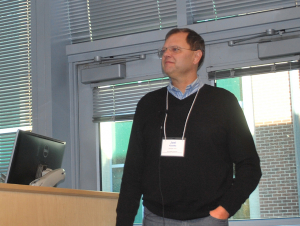
Gardeners love peat moss; it’s great for growing plants. But Joel Kostka, professor in the School of Biological Sciences and the School of Earth and Atmospheric Sciences, wonders if it serves as a warning sign for the impact of climate change on plants and microbes. He travels to a unique experimentation site in Minnesota to find answers to his questions.

“ASTOUNDING ELEMENTS,” an exhibit in Crosland Tower opening on Nov. 7, celebrates elements – real and fictional – and looks back at some events and artifacts from activities led by the College of Sciences.
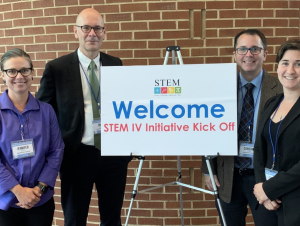
Georgia Tech is a new participant in the University System of Georgia (USG) STEM IV initiative, which was launched on October 29-30, in Athens, Georgia.
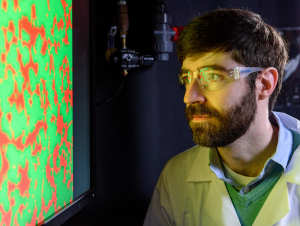
A team with promising technology to combat antibiotic resistance has received funding to accelerate commercialization. The team includes David Weiss, a clinical investigator and associate professor of infectious diseases at Emory University, and Peter Yunker, an assistant professor in the School of Physics and researcher in the Petit Institute for Bioengineering and Bioscience. A biophysicist, Yunker is the team’s technical investigator.

Chung Kim, an academic program coordinator in the College of Sciences, wins quiz 6 of ScienceMatters Season 3.
Experts In The News
In December, The Conversation hosted a webinar on AI’s revolutionary role in drug discovery and development. Science and technology editor Eric Smalley interviewed Jeffrey Skolnick, Regents' Professor and eminent scholar in computational systems biology at Georgia Institute of Technology, and Benjamin P. Brown, assistant professor of pharmacology at Vanderbilt University. Skolnick has developed AI-based approaches to predict protein structure and function that may help with drug discovery and finding off-label uses of existing drugs. Brown’s lab works on creating new computer models that make drug discovery faster and more reliable.
The Conversation April 7, 2026While it often gets written off as being distracted or not paying attention, daydreaming is actually a sign of an active and imaginative mind. In fact, a 2017 study found that daydreamers are generally smarter than their focused peers. “People with efficient brains may have too much brain capacity to stop their minds from wandering,” said Eric Schumacher, the Georgia Tech psychology professor who co-authored the study.
People who daydream frequently have things running through their heads, whether they are thinking through ideas or picturing possible outcomes. Letting the mind wander allows unexpected connections to form. To an outside observer, they may seem checked out of reality. However, other highly intellectual people know that they're truly deeply engaged, just not with what's going on right in front of them.
Your Tango April 4, 2026