To request a media interview, please reach out to experts using the faculty directories for each of our six schools, or contact Jess Hunt-Ralston, College of Sciences communications director. A list of faculty experts is also available to journalists upon request.
News Center
Latest News
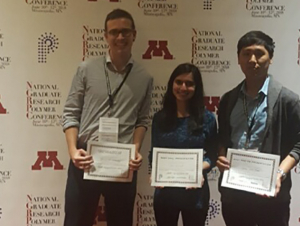
The 2018 National Graduate Research Polymer Conference (NGRPC18) recognized three Georgia Tech Ph.D. students for outstanding presentations.
- Aditi Khirbat – top oral presentation
- Brian Schmatz – runner-up oral presentation
- Young Jun Yoon – top poster presentation
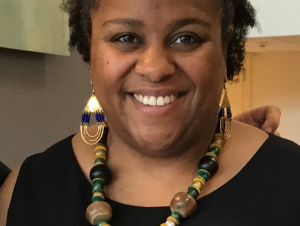
Kennda Lynch believes certain microorganisms in Pilot Valley must be using perchlorate as energy source. Because no one knows what these microbes are, Lynch will spend the next year finding out. Supporting her work is a recently announced Ford Foundation fellowship.
This summer, the School of Mathematics continues its rich history of undergraduate research, which testifies to faculty’s intellectual creativity and dedication to undergraduate education.

OceanVisions organizers see the dawning of a new phase of optimism for the health of our oceans. They know that solutions are available to help oceans adapt to or mitigate human and environmental assaults.
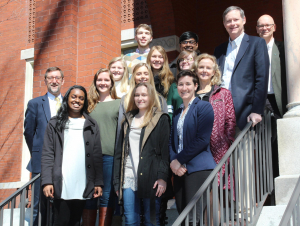
Recipients of Leddy Family Scholarships excel academically and partake of experiential education.
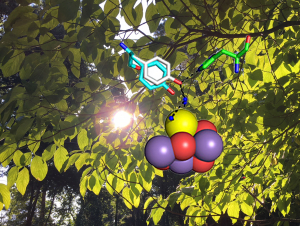
Oxygen photosynthesis has to be the greatest giver of life on Earth, and researchers have cracked yet another part of its complex but efficient chemistry. The more we know about it, the better we may be able to tweak photosynthesis, if it comes under environmental duress. It's also a great teacher of how to harvest sheer unlimited energy from the sun.
Experts In The News
Researchers have long known that when two galaxies approach each other and merge, the supermassive black holes at their centers form a pair and are eventually expected to merge as well. It is precisely these mergers that are considered one of the sources of the gravitational-wave background — a faint “hum” of spacetime detected in recent years. However, the role played by the geometry of the collision in this process has remained an open question.
Graduate student Sena Ghobadi of the Georgia Institute of Technology’s School of Physics, along with her colleagues, has developed three-dimensional dynamic models of such collisions.
A similar story appeared in Sky & Telescope.
Universe Magazine April 28, 2026Zachary Handlos, senior academic professional in the School of Earth and Atmospheric Sciences, explains how weather patterns can lead to conditions conducive to the types of wildfires currently seen in Florida and Georgia.
This piece also appeared in The Washington Post and The Conversation.
Atlanta Journal Constitution April 25, 2026