To request a media interview, please reach out to experts using the faculty directories for each of our six schools, or contact Jess Hunt-Ralston, College of Sciences communications director. A list of faculty experts is also available to journalists upon request.
News Center
Latest News
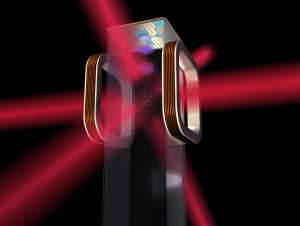
Know those particles that can be in two places at the same time and are not just particles but also waves? They appear to move in even weirder ways than previously thought. Theoretical physicists at Georgia Tech applied a week's worth of extreme computing power to predict the movements of fermions by including quantum optics, or light-like, ideas in their mathematical, theoretical modeling of how these specks of ultracold matter take flight.
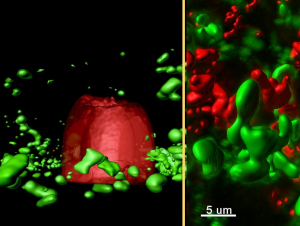
Despite the wealth of information about how bacteria communicate, little is known about how quorum sensing proceeds during an infection. Georgia Tech researchers describe for the first time how close bacteria need to be to “talk” in an environment similar to chronic infection in cystic fibrosis.
Until a permanent chair is appointed, Mark Wheeler will serve as interim chair of the School of Psychology.

School of Chemistry and Biochemistry Assistant Professor Henry La Pierre has received a Beckman Young Investigator Award to pursue research that would establish the foundation for innovations in magnetic materials based on f-block elements.

The National Science Foundation and Simons Foundation have launched a multimillion-dollar national project to advance mathematics and biology. The project comprises three centers, including one based in the Georgia Institute of Technology. The project aims to convey the benefits of physics’ age-old intertwining with math upon biology, a science historically less connected with it.
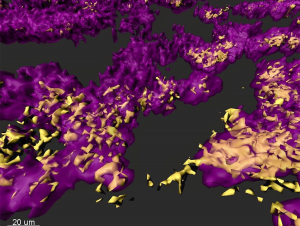
Most of what we know today about deadly bacteria such as Pseudomonas aeruginosa was obtained from studies done in laboratory settings. Research reported May 14 in the journal Proceedings of the National Academy of Sciences shows that this laboratory-based information may have important limits for predicting how these bugs behave once they’ve invaded humans.
Experts In The News
Researchers have long known that when two galaxies approach each other and merge, the supermassive black holes at their centers form a pair and are eventually expected to merge as well. It is precisely these mergers that are considered one of the sources of the gravitational-wave background — a faint “hum” of spacetime detected in recent years. However, the role played by the geometry of the collision in this process has remained an open question.
Graduate student Sena Ghobadi of the Georgia Institute of Technology’s School of Physics, along with her colleagues, has developed three-dimensional dynamic models of such collisions.
A similar story appeared in Sky & Telescope.
Universe Magazine April 28, 2026Zachary Handlos, senior academic professional in the School of Earth and Atmospheric Sciences, explains how weather patterns can lead to conditions conducive to the types of wildfires currently seen in Florida and Georgia.
This piece also appeared in The Washington Post and The Conversation.
Atlanta Journal Constitution April 25, 2026