To request a media interview, please reach out to experts using the faculty directories for each of our six schools, or contact Jess Hunt-Ralston, College of Sciences communications director. A list of faculty experts is also available to journalists upon request.
News Center
Latest News

The newly redesigned course, APPH 1040: Scientific Foundations of Health, expands the Institute’s First-Year Wellness Experience and provides students with practical wellness tools and strategies for college life and beyond.
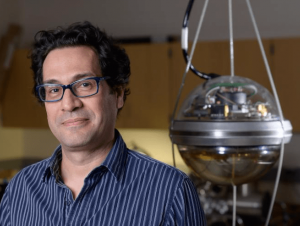
Ignacio Taboada has been awarded an NSF grant to build a sensor trigger system for the Pacific Ocean Neutrino Experiment — a powerful neutrino detector that will be built more than 2,600 meters under the surface of the Pacific Ocean, providing a new window into neutrino astrophysics.

Researchers combine deep learning with advanced sequencing techniques to predict how antibodies interact with antigens.

Highlighting their potential to make significant contributions to science and technology, four College of Sciences Ph.D. candidates have earned the prestigious Achievement Rewards for College Scientists (ARCS) Foundation Scholar Award. The new scholars join three returning College of Sciences ARCS recipients.

The School of Psychology, led by Chair Tansu Celikel, has launched Deep Dive into Brain and Behavior (D2B2), an AI-generated podcast that distills the School's latest research in psychology and neuroscience into engaging, easy-to-understand episodes. Using Google's NotebookLM, the podcast aims to make complex scientific findings accessible to a wide audience, from students to experts, while maintaining accuracy through author reviews.

Dana Randall, a professor in the School of Computer Science, and Jacob Calvert, a postdoctoral fellow at the Institute for Data Engineering and Science, have formulated a theory of rattling that answers these fundamental questions.
Experts In The News
Researchers have long known that when two galaxies approach each other and merge, the supermassive black holes at their centers form a pair and are eventually expected to merge as well. It is precisely these mergers that are considered one of the sources of the gravitational-wave background — a faint “hum” of spacetime detected in recent years. However, the role played by the geometry of the collision in this process has remained an open question.
Graduate student Sena Ghobadi of the Georgia Institute of Technology’s School of Physics, along with her colleagues, has developed three-dimensional dynamic models of such collisions.
A similar story appeared in Sky & Telescope.
Universe Magazine April 28, 2026Zachary Handlos, senior academic professional in the School of Earth and Atmospheric Sciences, explains how weather patterns can lead to conditions conducive to the types of wildfires currently seen in Florida and Georgia.
This piece also appeared in The Washington Post and The Conversation.
Atlanta Journal Constitution April 25, 2026