For Elliot Huang, success has never been about choosing the most obvious or well-traveled path. Instead, his time at Georgia Tech has been defined by a drive to bring together seemingly disparate interests — psychology and computer science — in pursuit of a deeper understanding of the human mind.
That interdisciplinary focus has earned Huang statewide recognition. He has been selected as Georgia Tech’s 2026 representative for the University System of Georgia’s (USG) Academic Recognition Day, an honor awarded annually to one undergraduate from each USG institution for outstanding scholastic achievement. Georgia Tech’s representative is chosen by the academic associate deans from each of the Institute’s six colleges, in collaboration with the Office of the Vice Provost for Undergraduate Education and Student Success.
This honor encourages Huang to keep pursuing the kind of research he believes can make a real difference.
It’s a form of external validation that the work I’m doing is meaningful, not just to me, but to others,” he said. “It confirms that choosing a less conventional path, one guided by impact instead of convenience, is worthwhile.
Huang has also received the 2026 Provost’s Academic Excellence Award. He will graduate in May with bachelor’s degrees in computer science and psychology, along with minors in computation and cognition, health and medical sciences, and the science of mental health and well-being.
He currently leads two projects investigating cognition in neural systems, supported by the President’s Undergraduate Research Award and the Petit-Lanier Research Scholarship. One project uses tobacco hawkmoths as a reduced-complexity model system to identify fundamental principles of neural computation. The other examines human learning and decision-making using a custom sensorimotor paradigm and computational modeling.
Huang has presented his findings at venues such as the Society for Integrative and Comparative Biology Annual Meeting and the Southeastern Medical Scientist Symposium, and he is preparing first-author manuscripts for submission later this spring.
According to Professor Simon Sponberg, who has advised Huang in the Agile Systems Lab, it’s Huang’s approach to his work that sets him apart.
“Elliot’s excellence goes beyond easily quantified metrics of academics,” Sponberg said. “He is exceptionally self-motivated and is constantly in pursuit of his goals. Combined with his effectiveness, ambition, and demonstrated responsibility he has already realized outstanding success, and I’m excited to see what he achieves next!”
That same confidence in Huang’s future is shared by Associate Professor Robert Wilson, Huang’s mentor and principle investigator in the Neuroscience of Reinforcement Learning and Decision-Making Lab.
“Elliot stands out as a truly brilliant scholar — a hard worker, deep thinker and all-around wonderful person to have in the lab,” Wilson said. “His research asks deep questions about the role of physical movement in human cognition that has the potential to revolutionize how we think about human learning and psychiatric disorders.”
Huang traces his interest in psychology to deeply personal experiences that reshaped how he viewed the intersection of technology, medicine, and well-being. While he was initially drawn to Tech’s computer science program, his academic focus evolved as he became more involved in mentorship and campus ministry, and as mental health challenges affected those close to him.
Those experiences ultimately solidified his goal of becoming a physician-scientist working at the intersection of computational modeling and psychiatry. Huang hopes to reframe psychiatric disorders not simply as collections of symptoms, but as variations in underlying cognitive processes. He hopes this approach will one day support more precise, mechanistic mental health care.
Huang has also invested significant time in mentoring peers and building his campus community. He leads Bible studies through Navigators Campus Ministry, previously served as director of operations for the Georgia Tech Medical Robotics Club, and has performed with the Institute’s Tenor Bass Choir.
After graduation, Huang plans to spend a year working as a full-time researcher while applying to MD/Ph.D. programs. Wherever that next step takes him, Huang leaves Georgia Tech with a foundation built on academic rigor and a commitment to improving human well-being.
Related Media
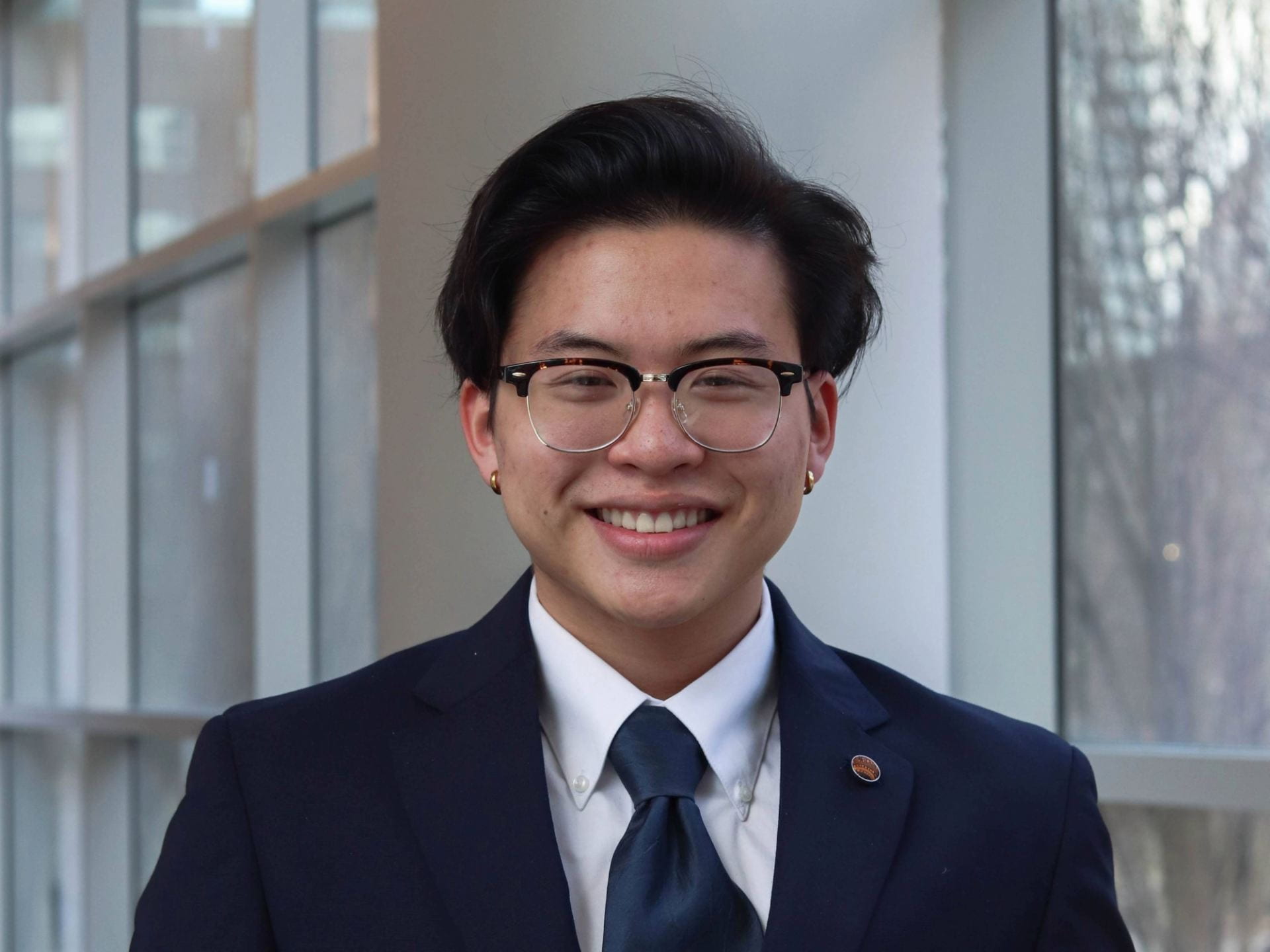
Elliot Huang will graduate in May with bachelor’s degrees in psychology and computer science.
For More Information Contact
Alex Howard
Office of Undergraduate Education & Student Success