College of Sciences

Latest News

GT NEXT 2025 Recipients

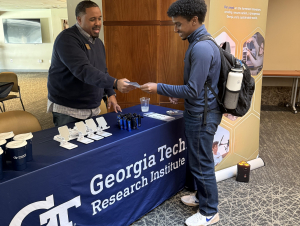
The Office of Technology Licensing has announced the 2025 recipients of the GT NEXT awards, a grant that helps students advance their inventions toward market readiness. Providing early momentum for promising technologies, the grants help students move their research toward real-world impact. 

A lizard wearing one of the sensors, which weigh just three-hundredths of a gram each — the same as a two grains of rice. (Credit: Jon Suh)

The award will support Stroud as he creates evolution’s first high-definition map — with the help of 1,000 backpack-wearing lizards.

Wheaton.jpg

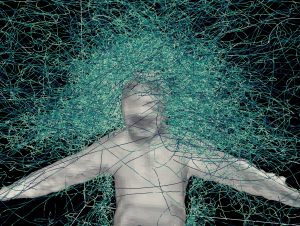
Neuroscience experts from across Georgia Tech will soon come together for a new interdisciplinary research institute, the Institute for Neuroscience, Neurotechnology, and Society (INNS), launched in July. Faculty in INNS are helping to solve some of neuroscience’s most pressing problems, and many have promising medical applications. One important aspect of studying the brain is understanding how the brain and the body work together. Meet the researchers who study brain-body interactions, from monitoring the neuron degradation that causes Alzheimer’s to enhancing mobility for stroke survivors, in an effort to improve the health and quality of life for millions of Americans.

Grace Tang (Left) and Alison Onstine (Right) holding bacteria plates that spell "BIOL 4590" (Credit: Tang and Onstine)

“This course truly underscores Georgia Tech’s commitment to pioneering meaningful undergraduate experiences,” says teacher Vinayak (Vinny) Agarwal. “No other peer institution I know of is exposing undergraduates to bioinformatics at this level.”

AdobeStock_478449398.jpeg

As climate change influences hurricane behavior, experts are taking a closer look at how we classify and communicate storm risks, and what that means for forecasting, preparedness, and public understanding.

Post-hurricane flooding inundates residential areas and transportation infrastructure, with low-lying terrain overwhelmed by storm surge and excessive rainfall.

Georgia Tech researchers are developing solutions to monitor and forecast flooding, as well as restore ecosystems to prevent future flooding. These efforts support communities’ resilience in the face of climate change and keep the U.S. secure.

Experts In The News

In an article published by The Conversation, Benjamin Freeman, assistant professor in the School of Biological Sciences, discusses his research, including a recent study on how mountain birds in the Pacific Northwest are responding to climate change.

The Conversation November 27, 2025

Assistant Professor Christopher Carr co-authored an article published in The Conversation that discusses NASA's ESCAPADE mission to Mars. Carr characterizes the mission as a “testament to a new era in spaceflight”.

The Conversation November 13, 2025

Upcoming Events

Jan
14
2026
Jan
16
2026
Join the Spatial Ecology and Paleontology Lab for Fossil Fridays! Become a fossil hunter and help discover how vertebrate communities have changed through time.
Jan
22
2026
On the grounds between the Howey and Mason Buildings, several telescopes are typically set up for viewing, and visitors are also invited to bring their own telescope.
Jan
23
2026
Join the Spatial Ecology and Paleontology Lab for Fossil Fridays! Become a fossil hunter and help discover how vertebrate communities have changed through time.

Spark: College of Sciences at Georgia Tech

Welcome — we're so glad you're here. Learn more about us in this video, narrated by Susan Lozier, College of Sciences Dean and Sutherland Chair.