To request a media interview, please reach out to experts using the faculty directories for each of our six schools, or contact Jess Hunt-Ralston, College of Sciences communications director. A list of faculty experts is also available to journalists upon request.
News Center
Latest News
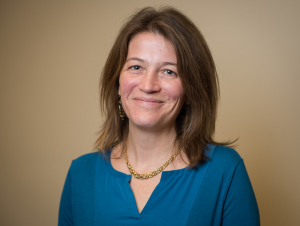
Cadonati, a professor in the School of Physics and director of the Center for Relativistic Astrophysics, has also held leadership positions in LIGO — including leading its data analysis and astrophysics division at the time of the discovery of gravitational waves, which led to the 2017 Nobel prize in Physics to the founders of the project.
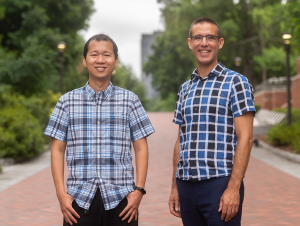
The NIH-funded program is designed to train a new generation of biomedical researchers and thought leaders to harness the data revolution.
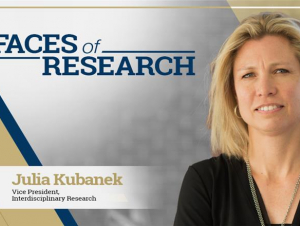
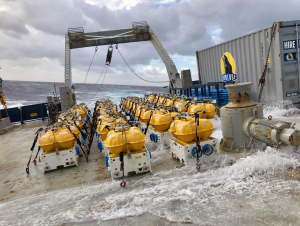
Tectonic plates colliding deep below the ocean's surface can trigger major earthquakes and tsunamis. Now, a new study from a collaborative team of scientists including Samer Naif, assistant professor in the School of Earth and Atmospheric Sciences, shows that water may play a bigger role than previously understood in the magnitude of these underwater quakes.

In June, the first ever joint symposium of the Center for Microbial Dynamics and Infection at Georgia Tech (CMDI) and Centers for Disease Control and Prevention (CDC) brought together interdisciplinary researchers to discuss infectious disease dynamics.
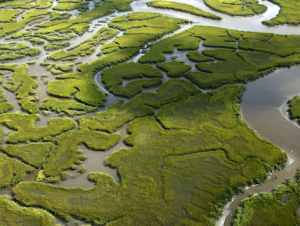
The Georgia Climate Project was founded in 2018 as a collaborative effort between Emory University, the Georgia Institute of Technology, and the University of Georgia. Its scope has since expanded to include Agnes Scott College, Columbus State University, Georgia Southern University, Georgia State University, Spelman College, and the University of North Georgia.
Experts In The News
Alex Robel, an associate professor in the School of Earth and Atmospheric Sciences at Georgia Tech, said pumping sand onshore is far from a perfect solution to stabilize a beach, but it’s “one of the best tools we have in our arsenal.”
“It’s been done in the United States for almost a century in different places and we know how to do it,” Robel said. “We’re good at it.”
But nourishment is only a Band-Aid for erosion. Once cities start replenishing sand, Robel said they have to keep doing it regularly.
Atlanta Journal Constitution March 24, 2026A team of researchers including David Hu, a professor in Georgia Tech’s School of Biological Sciences and George W. Woodruff School of Mechanical Engineering, have visualized mosquito flight behavior for the first time.
Based on their data, the researchers said they don’t think mosquitoes swarm because they’re following the pack. Each appeared to pick up on the cues independently, then found themselves at the same place at the same time.
“It’s like a crowded bar,” said Hu. “Customers aren’t there because they followed each other into the bar. They’re attracted by the same cues: drinks, music, and the atmosphere. The same is true of mosquitoes. Rather than following the leader, the insect follows the signals and happens to arrive at the same spot as the others. They’re good copies of each other.”
A similar story was published by The Economic Times.
ScienceDaily March 22, 2026