To request a media interview, please reach out to experts using the faculty directories for each of our six schools, or contact Jess Hunt-Ralston, College of Sciences communications director. A list of faculty experts is also available to journalists upon request.
News Center
Latest News
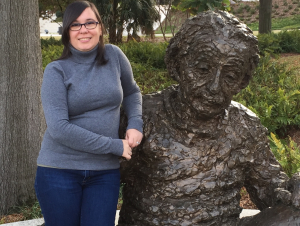
June is National Cancer Survivor Month, an opportunity for the nearly 17 million cancer survivors across the country to tell their stories, celebrate milestones, and recognize those who have supported them along the way. Emily Alicea-Muñoz, academic professional in the School of Physics, shares her journey with breast cancer, advice for supporting loved ones living with cancer, and hopes for the future of cancer research.
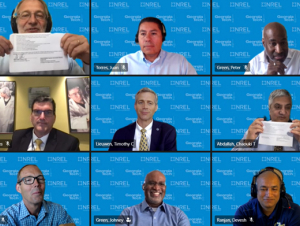
Georgia Tech and the U.S. DOE's National Renewable Energy Laboratory (NREL) have entered into an agreement to bolster the interactions, collaborations, and joint scientific output of both institutions.

A quartet of School of Physics researchers has come up with a roadmap that blends powerful new machine learning tools with traditional scientific investigative techniques and theories, all in the hopes of solving the biggest problems in science, engineering, and medicine.
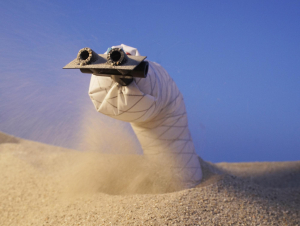
We’ve seen robots take to the air, dive beneath the waves, and perform all sorts of maneuvers on land. Now, physicists at Georgia Tech and engineers at UC Santa Barbara are exploring the shallow underground world with a fast, steerable, burrowing soft robot.

SPRUCE experiment study shows elevated levels of greenhouse gases emerging from carbon-rich peatlands
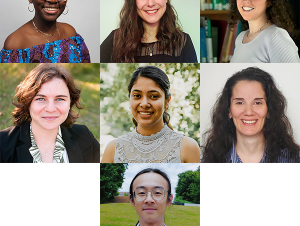
The inaugural class of seven Brook Byers Institute for Sustainable Systems (BBISS) Graduate Research Assistant (GRA) Scholars was recently selected for a 2-year program of working, studying, and training as an interdisciplinary sustainability research team. Launching in the Fall of 2021 with funding provided by a generous gift from Brook and Shawn Byers and guidance from a Faculty Advisory Board, the BBISS GRA Scholars will receive supplemental training in sustainability, team science, and leadership. They will apply their skills and talents, working directly with their peers, faculty, and external partners on a long-term, large team, sustainability relevant Vertically Integrated Project. They will participate in the organization and hosting of a seminar series in which they will invite and meet global leaders in sustainability, and they will have additional opportunities to develop professional networks, to publish, to draft proposals, to acquire knowledge, and to develop other skills critical to their professional success and relevant to their intellectual interests.
Read More...
Experts In The News
Alex Robel, an associate professor in the School of Earth and Atmospheric Sciences at Georgia Tech, said pumping sand onshore is far from a perfect solution to stabilize a beach, but it’s “one of the best tools we have in our arsenal.”
“It’s been done in the United States for almost a century in different places and we know how to do it,” Robel said. “We’re good at it.”
But nourishment is only a Band-Aid for erosion. Once cities start replenishing sand, Robel said they have to keep doing it regularly.
Atlanta Journal Constitution March 24, 2026A team of researchers including David Hu, a professor in Georgia Tech’s School of Biological Sciences and George W. Woodruff School of Mechanical Engineering, have visualized mosquito flight behavior for the first time.
Based on their data, the researchers said they don’t think mosquitoes swarm because they’re following the pack. Each appeared to pick up on the cues independently, then found themselves at the same place at the same time.
“It’s like a crowded bar,” said Hu. “Customers aren’t there because they followed each other into the bar. They’re attracted by the same cues: drinks, music, and the atmosphere. The same is true of mosquitoes. Rather than following the leader, the insect follows the signals and happens to arrive at the same spot as the others. They’re good copies of each other.”
A similar story was published by The Economic Times.
ScienceDaily March 22, 2026