To request a media interview, please reach out to experts using the faculty directories for each of our six schools, or contact Jess Hunt-Ralston, College of Sciences communications director. A list of faculty experts is also available to journalists upon request.
News Center
Latest News

Two interdisciplinary research teams have been awarded 2021 Petit Institute Seed Grants. School of Biological Sciences' Alberto Stolfi is teaming up with Coulter Department of Biomedical Engineering's Shu Jia to link novel biological discovery with transformative imaging technology. Liang Han (Biological Sciences) and Costas Arvanitis (Biomedical Engineering) will explore how sound and vibration interact with cell membrane proteins in hopes of creating noninvasive neuroscience tools.
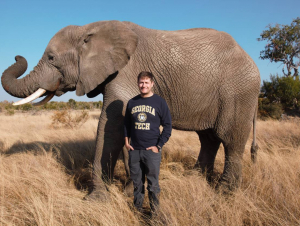
New research from Georgia Tech finds that elephants dilate their nostrils in order to create more space in their trunks, allowing them to store up to 5.5 liters of water. They can also suck up three liters per second — a speed 30 times faster than a human sneeze. Researchers share that the animal's “Swiss Army Knife” could help build better robots.

An assistant professor from the School of Earth and Atmospheric Sciences led a research team that has uncovered evidence of smoke aerosols in the Earth's atmosphere in the past, leading to possible new insight about global climate change's impact.

School of Biological Sciences’ Jeffrey Skolnick and Hongyi Zhou are part of an award-winning NIH effort to create innovative, AI-powered platforms for discovering new pain management drugs — and identify immediate solutions.
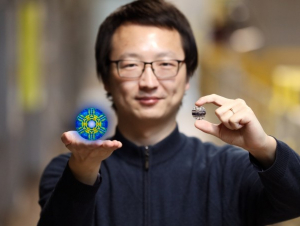
Advanced materials with more novel properties are almost always developed by adding more elements to the list of ingredients. But quantum research suggests some simpler materials might already have advanced properties that scientists just couldn’t see, until now, thanks to new work from researchers at Georgia Tech and the University of Tennessee–Knoxville.
Georgia Tech Institute for Materials (IMat) has created a new Science Advisor position and a team of Initiative Leaders to shape the future of IMat. School of Physics' Martin Mourigal will serve as 2021 Science Advisor, and Chandra Raman as 2021 Initiative Lead for Condensed Matter: Materials for Quantum Science and Technology.
Experts In The News
Alex Robel, an associate professor in the School of Earth and Atmospheric Sciences at Georgia Tech, said pumping sand onshore is far from a perfect solution to stabilize a beach, but it’s “one of the best tools we have in our arsenal.”
“It’s been done in the United States for almost a century in different places and we know how to do it,” Robel said. “We’re good at it.”
But nourishment is only a Band-Aid for erosion. Once cities start replenishing sand, Robel said they have to keep doing it regularly.
Atlanta Journal Constitution March 24, 2026A team of researchers including David Hu, a professor in Georgia Tech’s School of Biological Sciences and George W. Woodruff School of Mechanical Engineering, have visualized mosquito flight behavior for the first time.
Based on their data, the researchers said they don’t think mosquitoes swarm because they’re following the pack. Each appeared to pick up on the cues independently, then found themselves at the same place at the same time.
“It’s like a crowded bar,” said Hu. “Customers aren’t there because they followed each other into the bar. They’re attracted by the same cues: drinks, music, and the atmosphere. The same is true of mosquitoes. Rather than following the leader, the insect follows the signals and happens to arrive at the same spot as the others. They’re good copies of each other.”
A similar story was published by The Economic Times.
ScienceDaily March 22, 2026