To request a media interview, please reach out to experts using the faculty directories for each of our six schools, or contact Jess Hunt-Ralston, College of Sciences communications director. A list of faculty experts is also available to journalists upon request.
News Center
Latest News
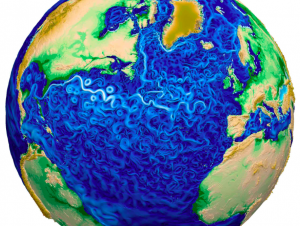
The Department of Energy's process for predicting how climate change will affect carbon in the planet's ecosystem could get a makeover, thanks to a new grant for two School of Earth and Atmospheric Sciences researchers.
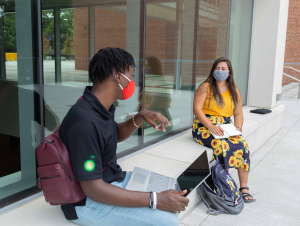
As we start fall semester and a fresh school year, second year neuroscience major Annabelle Thomas joins Fredrick Holloman, a learning specialist and academic coach in Georgia Tech Tutoring & Academic Support, to share top tips for a successful semester.
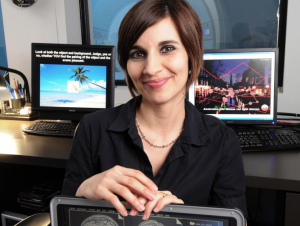
A new at-home polysomnography kit, built by Audrey Duarte and W. Hong Yeo, proposes a path to getting data and a better night’s sleep — thanks to a new, unobtrusive nanotech device.
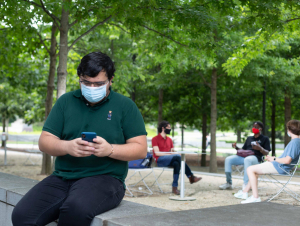
The smartphones in everyone’s purse or pocket could soon become powerful tools in the effort to control coronavirus in the campus community.

NASA Dawn's second mission sheds new light on dwarf planet Ceres — including evidence of dome-like, ice-filled hills that resemble Earth's 'pingos'. The work could lead to new insights about the role of water in shaping the geology of icy bodies elsewhere in the solar system, and a better understanding of pingos in relation to Earth’s climate. The team has also received a grant for what will be the first-ever mapping of similar features in the Arctic: Pingo STARR.

Video recap: Watch Joshua Weitz and Greg Gibson provide updates on Covid-19 projections and coronavirus surveillance testing, with a focus on the return to campus.
Experts In The News
In December, The Conversation hosted a webinar on AI’s revolutionary role in drug discovery and development. Science and technology editor Eric Smalley interviewed Jeffrey Skolnick, Regents' Professor and eminent scholar in computational systems biology at Georgia Institute of Technology, and Benjamin P. Brown, assistant professor of pharmacology at Vanderbilt University. Skolnick has developed AI-based approaches to predict protein structure and function that may help with drug discovery and finding off-label uses of existing drugs. Brown’s lab works on creating new computer models that make drug discovery faster and more reliable.
The Conversation April 7, 2026While it often gets written off as being distracted or not paying attention, daydreaming is actually a sign of an active and imaginative mind. In fact, a 2017 study found that daydreamers are generally smarter than their focused peers. “People with efficient brains may have too much brain capacity to stop their minds from wandering,” said Eric Schumacher, the Georgia Tech psychology professor who co-authored the study.
People who daydream frequently have things running through their heads, whether they are thinking through ideas or picturing possible outcomes. Letting the mind wander allows unexpected connections to form. To an outside observer, they may seem checked out of reality. However, other highly intellectual people know that they're truly deeply engaged, just not with what's going on right in front of them.
Your Tango April 4, 2026