To request a media interview, please reach out to experts using the faculty directories for each of our six schools, or contact Jess Hunt-Ralston, College of Sciences communications director. A list of faculty experts is also available to journalists upon request.
News Center
Latest News
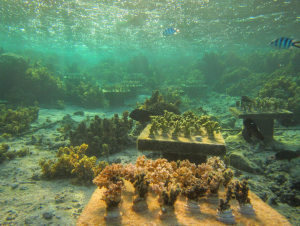
The effective extinction of many coral species may be weakening reef systems thus siphoning life out of the corals that remain. A new study found that corals fared much worse without the company of other coral species.
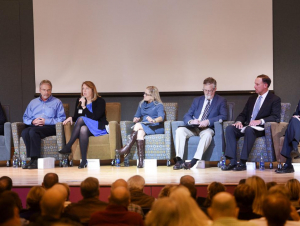
At the College of Coastal Georgia, Kim Cobb joins the state's top experts to discuss the current state of sea-level rise. They touched on the social and economic consequences of flooding, what's in store for the future, and more.

Georgia Tech researchers from the School of Physics and the School of Chemistry and Biochemistry led an international team that made a surpising discovery in the field of 2D materials.
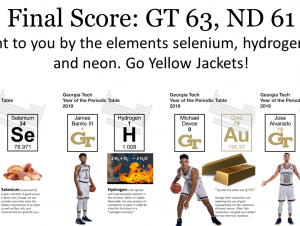
Led by the College of Sciences, Georgia Tech launched its year-long celebration of 2019, the International Year of the Periodic Table, at the Jan. 22 men's basketball game against Notre Dame. The Yellow Jackets prevailed over the Fighting Irish, 63-61.
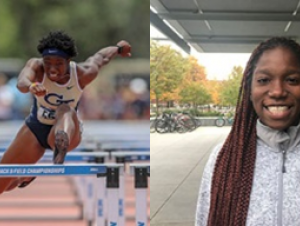
To celebrate the International Year of the Periodic Table, Tech students, faculty, and staff talk about their favorite elements. For January, we have biochemistry major and track star Jeanine Williams.

The light released from around the first massive black holes in the universe is so intense that it is able to reach telescopes across the entire expanse of the universe. Incredibly, the light from the most distant black holes (or quasars) has been traveling to us for more than 13 billion light years. However, we do not know how these monster black holes formed.
Experts In The News
Researchers have long known that when two galaxies approach each other and merge, the supermassive black holes at their centers form a pair and are eventually expected to merge as well. It is precisely these mergers that are considered one of the sources of the gravitational-wave background — a faint “hum” of spacetime detected in recent years. However, the role played by the geometry of the collision in this process has remained an open question.
Graduate student Sena Ghobadi of the Georgia Institute of Technology’s School of Physics, along with her colleagues, has developed three-dimensional dynamic models of such collisions.
A similar story appeared in Sky & Telescope.
Universe Magazine April 28, 2026Zachary Handlos, senior academic professional in the School of Earth and Atmospheric Sciences, explains how weather patterns can lead to conditions conducive to the types of wildfires currently seen in Florida and Georgia.
This piece also appeared in The Washington Post and The Conversation.
Atlanta Journal Constitution April 25, 2026