To request a media interview, please reach out to experts using the faculty directories for each of our six schools, or contact Jess Hunt-Ralston, College of Sciences communications director. A list of faculty experts is also available to journalists upon request.
News Center
Latest News
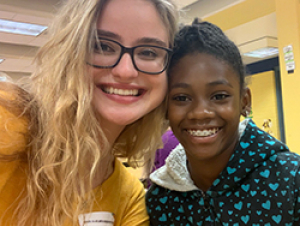
Biochemistry major Diana Toro and Computer Science major Tessa Stubbs partnered with Discovery to begin the Little Einsteins Organization, a STEM-focused, after-school program for elementary school students.
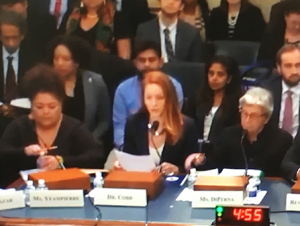
Kim Cobb testifies before the House of Representatives' Natural Resources Committee hearing on climate change. She urges early action to counter the devastating impacts of climate change.
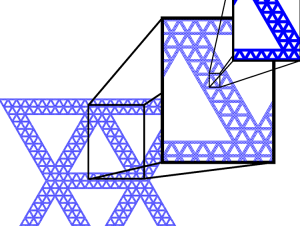
Conventional wisdom says complex structures should be harder to assemble than simple ones. Their assembly requires more information and presents more opportunities to make mistakes. But in nature, complex assemblies and higher error rates do not necessarily mean higher failure rates.
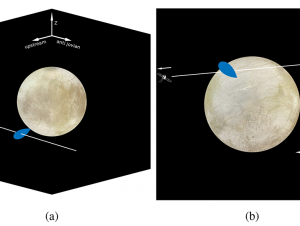
Georgia Tech researchers uncovered a previously unrecognized encounter between a plume from Jupiter's moon Europa and the spacecraft Galileo almost 20 years ago.
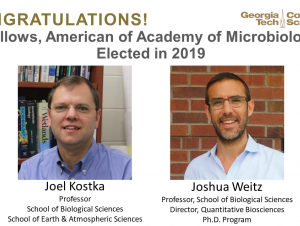
The American Academy of Microbiology (AAM) has elected 109 new fellows in 2019. Among them are Joel Kostka and Joshua Weitz.
Experts In The News
Researchers have long known that when two galaxies approach each other and merge, the supermassive black holes at their centers form a pair and are eventually expected to merge as well. It is precisely these mergers that are considered one of the sources of the gravitational-wave background — a faint “hum” of spacetime detected in recent years. However, the role played by the geometry of the collision in this process has remained an open question.
Graduate student Sena Ghobadi of the Georgia Institute of Technology’s School of Physics, along with her colleagues, has developed three-dimensional dynamic models of such collisions.
A similar story appeared in Sky & Telescope.
Universe Magazine April 28, 2026Zachary Handlos, senior academic professional in the School of Earth and Atmospheric Sciences, explains how weather patterns can lead to conditions conducive to the types of wildfires currently seen in Florida and Georgia.
This piece also appeared in The Washington Post and The Conversation.
Atlanta Journal Constitution April 25, 2026