To request a media interview, please reach out to experts using the faculty directories for each of our six schools, or contact Jess Hunt-Ralston, College of Sciences communications director. A list of faculty experts is also available to journalists upon request.
News Center
Latest News
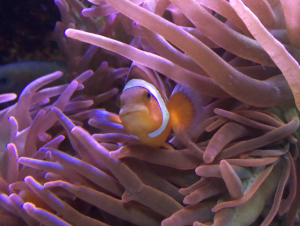
The fish killer and the fish live in perfect harmony: But how the clownfish thrives in the venomous tentacles of the anemone remains a mystery. A new study tackles the iconic conundrum from the microbial side by watching bacterial colonies shift in fish mucus, as the clownfish cozy up to anemones.
Kim Cobb talks to Vice about the disastrous effects of huricanes caused by climate change.
Kim Cobb organized an open letter challenging the AGU's decision to honor an anti- environment senator.
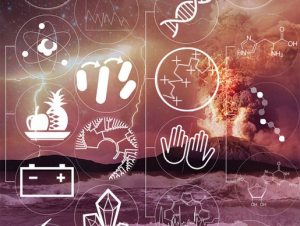
Humans will soon embark on a detailed characterization of habitable planets beyond the solar system. Space-based telescopes probing the atmospheres of small planets around nearby stars will shortly be joined by ground-based observatories. What should these instruments be looking for?
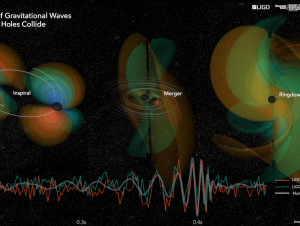
Scientists from around the world have now observed 10 black hole collisions and a merger of two binary neutron stars using LIGO and the European-based Virgo gravitational wave detector. A new catalog inventories those events.
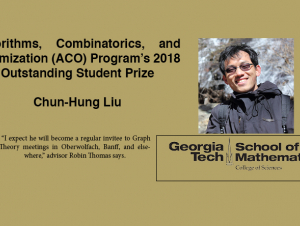
The Georgia Tech Algorithms, Combinatorics, and Optimization Program (ACO) has selected Chun-Hung Liu to receive the 2018 ACO Outstanding Student Prize. The award recognizes academic excellence in the areas represented by ACO.The Georgia Tech Algorithms, Combinatorics, and Optimization Program (ACO) has selected Chun-Hung Liu to receive the 2018 ACO Outstanding Student Prize. The award recognizes academic excellence in the areas represented by ACO.
Experts In The News
Researchers have long known that when two galaxies approach each other and merge, the supermassive black holes at their centers form a pair and are eventually expected to merge as well. It is precisely these mergers that are considered one of the sources of the gravitational-wave background — a faint “hum” of spacetime detected in recent years. However, the role played by the geometry of the collision in this process has remained an open question.
Graduate student Sena Ghobadi of the Georgia Institute of Technology’s School of Physics, along with her colleagues, has developed three-dimensional dynamic models of such collisions.
A similar story appeared in Sky & Telescope.
Universe Magazine April 28, 2026Zachary Handlos, senior academic professional in the School of Earth and Atmospheric Sciences, explains how weather patterns can lead to conditions conducive to the types of wildfires currently seen in Florida and Georgia.
This piece also appeared in The Washington Post and The Conversation.
Atlanta Journal Constitution April 25, 2026