To request a media interview, please reach out to experts using the faculty directories for each of our six schools, or contact Jess Hunt-Ralston, College of Sciences communications director. A list of faculty experts is also available to journalists upon request.
News Center
Latest News

Fifteen Georgia Tech scientists have made the 2018 Highly Cited Researchers list; nine of them are affiliated with the College of SciencesFifteen Georgia Tech scientists have made the 2018 Highly Cited Researchers list; nine of them are affiliated with the College of Sciences.
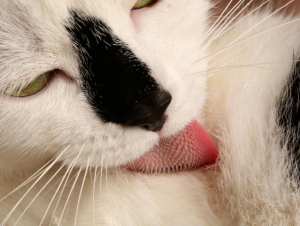

David Hu has investigated, horse tails, wet dog shakes, and sheep eyelashes. Now, he dives into cat tongues, discovering what exactly makes them so good at their job.

Fast Company reports on Rodney Weber's latest study. Weber and his team discovered that there is no such thing as a 3D printer that doesn't emit concerning microparticles into the air.

David Hu and his team have created a mathematical model that may serve as a blueprint for the perfect stir-fried rice.
Experts In The News
Researchers have long known that when two galaxies approach each other and merge, the supermassive black holes at their centers form a pair and are eventually expected to merge as well. It is precisely these mergers that are considered one of the sources of the gravitational-wave background — a faint “hum” of spacetime detected in recent years. However, the role played by the geometry of the collision in this process has remained an open question.
Graduate student Sena Ghobadi of the Georgia Institute of Technology’s School of Physics, along with her colleagues, has developed three-dimensional dynamic models of such collisions.
A similar story appeared in Sky & Telescope.
Universe Magazine April 28, 2026Zachary Handlos, senior academic professional in the School of Earth and Atmospheric Sciences, explains how weather patterns can lead to conditions conducive to the types of wildfires currently seen in Florida and Georgia.
This piece also appeared in The Washington Post and The Conversation.
Atlanta Journal Constitution April 25, 2026