To request a media interview, please reach out to experts using the faculty directories for each of our six schools, or contact Jess Hunt-Ralston, College of Sciences communications director. A list of faculty experts is also available to journalists upon request.
News Center
Latest News
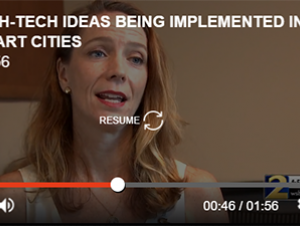
On WSB-TV2, Kim Cobb describes sea-level sensors deployed by Georgia Tech researchers in Savannah. First results in the aftermath of Hurricane Florence are just coming in.
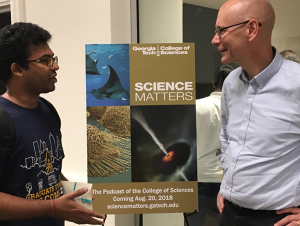
Sachin Sarath Yadav Kothandaraman, a graduate student in the Bioinformatics Graduate Program, won the ScienceMatters Episode 5 quiz. Kothandaraman is researching machine-learning tools to predict drug responses to cancers in Fredrik Vannberg's lab.

Simon Sponberg uses moths and cockroaches to study "the physics of living systems." With the help of virtual reality and video game principles, Sponberg's research into how animals move within their environments could lead to better robots, vehicles, and prosthetic devices.
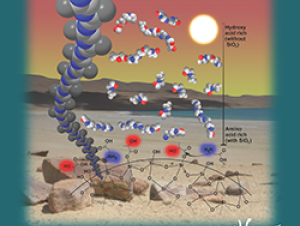
Work from the Center for Chemical Evolution suggests a mechanism by which organic compounds and silica, found in sand, could have produced long peptides in prebiotic Earth.
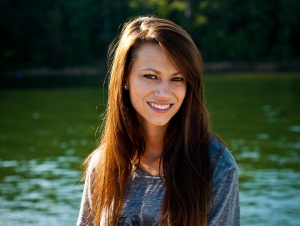
Allie Caughman, a 3rd year undergraduate student in the School of Biological Sciences, won the ScienceMatters Episode 4 quiz. Caughman is a member of Professor Frank Stewart's lab, and is researching microbiome changes on coral reefs.
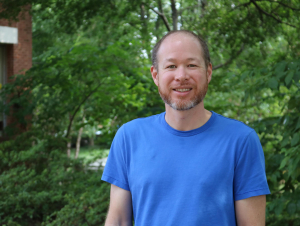
His visualizations of the heavens look like they are straight from Hollywood movie blockbusters. But John Wise's goal is to help researchers understand possible scenarios for the birth of stars and massive black holes. Wise talks about his research in ScienceMatters Episode 5.
Experts In The News
Researchers have long known that when two galaxies approach each other and merge, the supermassive black holes at their centers form a pair and are eventually expected to merge as well. It is precisely these mergers that are considered one of the sources of the gravitational-wave background — a faint “hum” of spacetime detected in recent years. However, the role played by the geometry of the collision in this process has remained an open question.
Graduate student Sena Ghobadi of the Georgia Institute of Technology’s School of Physics, along with her colleagues, has developed three-dimensional dynamic models of such collisions.
A similar story appeared in Sky & Telescope.
Universe Magazine April 28, 2026Zachary Handlos, senior academic professional in the School of Earth and Atmospheric Sciences, explains how weather patterns can lead to conditions conducive to the types of wildfires currently seen in Florida and Georgia.
This piece also appeared in The Washington Post and The Conversation.
Atlanta Journal Constitution April 25, 2026