To request a media interview, please reach out to experts using the faculty directories for each of our six schools, or contact Jess Hunt-Ralston, College of Sciences communications director. A list of faculty experts is also available to journalists upon request.
News Center
Latest News
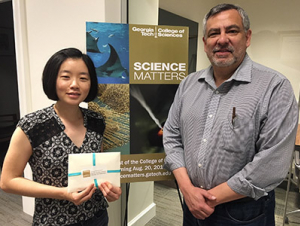
Kimberly Chen, a postdoctoral researcher in the School of Biological Sciences, won the ScienceMatters Episode 6 quiz. Chen studies the evolutionary transition from single-cell to multicellular organisms.
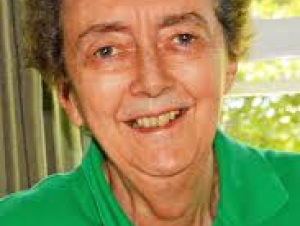
The late Elaine Hubbard gave generously to Georgia Tech during her lifetime, and her estate gift establishes the first endowed faculty chair in the School of Mathematics.
Optical tweezers are one of two inventions that won the 2018 Nobel Prize in Physics.
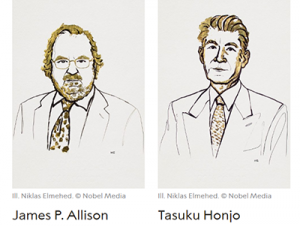
By combining technologies based on their discoveries with other ways to treat cancer, the hope is to transform the lethal disease to a manageable, chronic one.
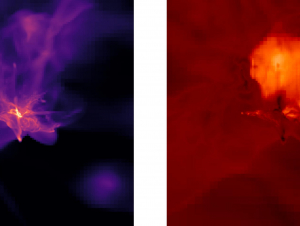
The first-of-its-kind simulation suggests that direct formation of these black holes would be accompanied by specific kinds of intense radiation, including X-rays and ultraviolet emission that would shift to infrared by the time they reach the telescope. The black holes would also likely spawn massive metal-free stars, a finding that was unexpected.
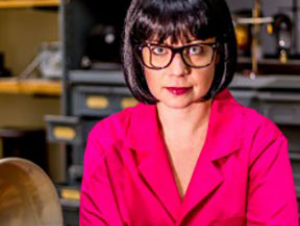
By day, she’s Jennifer Leavey, cademic professional in the School of Biological Sciences. When she straps on a guitar, Leavey becomes Leucine Zipper, leader of the rock band Zinc Fingers. For a change of pace, ScienceMatters samples the band’s science-inspired songs. Leavey shares how the band uses music and other media to teach science.
Experts In The News
Researchers have long known that when two galaxies approach each other and merge, the supermassive black holes at their centers form a pair and are eventually expected to merge as well. It is precisely these mergers that are considered one of the sources of the gravitational-wave background — a faint “hum” of spacetime detected in recent years. However, the role played by the geometry of the collision in this process has remained an open question.
Graduate student Sena Ghobadi of the Georgia Institute of Technology’s School of Physics, along with her colleagues, has developed three-dimensional dynamic models of such collisions.
A similar story appeared in Sky & Telescope.
Universe Magazine April 28, 2026Zachary Handlos, senior academic professional in the School of Earth and Atmospheric Sciences, explains how weather patterns can lead to conditions conducive to the types of wildfires currently seen in Florida and Georgia.
This piece also appeared in The Washington Post and The Conversation.
Atlanta Journal Constitution April 25, 2026