To request a media interview, please reach out to experts using the faculty directories for each of our six schools, or contact Jess Hunt-Ralston, College of Sciences communications director. A list of faculty experts is also available to journalists upon request.
News Center
Latest News
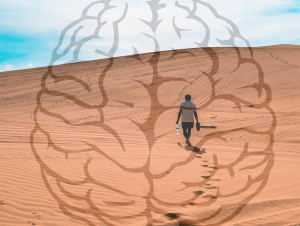
Sweating up a storm doing yard work? This is what your brain might be doing: Reasonably customary dehydration led to shape changes in the brains of test subjects in a new study. And neuronal firing patterns got nosier. The subjects' average performance of a motor task also slipped markedly.

Laughing gas and the mystery of Carl Sagan's Faint Young Sun Paradox: When the sun shone dimmer an eon ago, and was stingy with heat, Earth remained warm in spite of it likely thanks to a mix of greenhouse gases. Biogeochemists have now shown how nitrous oxide, known today for its use as a dental anesthetic, may have made it into the mix.
From credit hours to undergraduate research and getting help with course work, here are answers to questions frequently asked by new and returning students.
Although based on a graduate student’s perspective, Andrea Welsh’s tips also apply to undergrads, faculty, and staff.
Season 1 of the podcast of the College of Sciences is now available at sciencematters.gatech.edu.
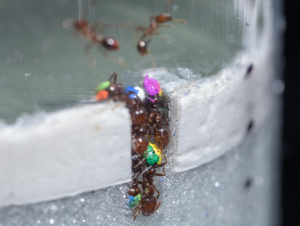
For ants and robots operating in confined spaces like tunnels, having more workers does not necessarily mean getting more work done. Just as too many cooks in a kitchen get in each other’s way, having too many robots in tunnels creates clogs that can bring the work to a grinding halt.
Experts In The News
Researchers have long known that when two galaxies approach each other and merge, the supermassive black holes at their centers form a pair and are eventually expected to merge as well. It is precisely these mergers that are considered one of the sources of the gravitational-wave background — a faint “hum” of spacetime detected in recent years. However, the role played by the geometry of the collision in this process has remained an open question.
Graduate student Sena Ghobadi of the Georgia Institute of Technology’s School of Physics, along with her colleagues, has developed three-dimensional dynamic models of such collisions.
A similar story appeared in Sky & Telescope.
Universe Magazine April 28, 2026Zachary Handlos, senior academic professional in the School of Earth and Atmospheric Sciences, explains how weather patterns can lead to conditions conducive to the types of wildfires currently seen in Florida and Georgia.
This piece also appeared in The Washington Post and The Conversation.
Atlanta Journal Constitution April 25, 2026