To request a media interview, please reach out to experts using the faculty directories for each of our six schools, or contact Jess Hunt-Ralston, College of Sciences communications director. A list of faculty experts is also available to journalists upon request.
News Center
Latest News
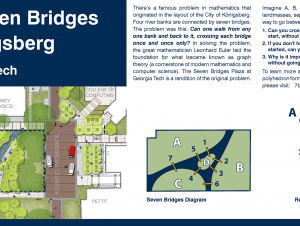
Mathematicians, musicians, and dancers demystify the 18th-century problem through puzzles, music, and dance.

Little is known about plant microbiomes, particularly those associated with salt-tolerant coastal plants like Spartina alterniflora, which dominate Georgia’s salt marshes. With funding from Georgia Sea Grant, Kostka is studying the microbes intimately associated with Spartina to better understand how the plant microbiome supports the health of Georgia’s salt marshes.
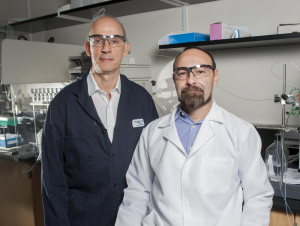
The parasite that causes leishmaniasis, a scary flesh-rotting disease, is tough to beat, says School of Chemistry and Biochemistry Professor and Chair M.G. Finn. It usually ravages equatorial countries but is now in North America. Finn is teaming with Brazilian scientists to work on a potential vaccine. And congratulations to Pedro Marquez Zacarias for nailing the episode 2 quiz.
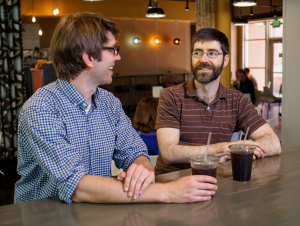
When Will Ratcliff and Peter Yunker first met for coffee they had no idea they would eventually collaborate on research that would be published in Nature Communications and Nature Physics.
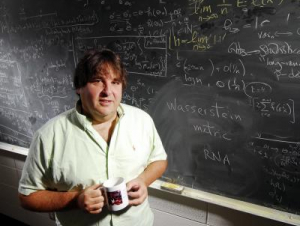
Using a mathematical model, Georgia Tech biomathematician Howard “Howie” Weiss and Stockholm University microbiologist Klas Udekwu open a potential path to slowing microbial resistance to current antibiotics.
Using a mathematical model, Georgia Tech biomathematician Howard “Howie” Weiss and Stockholm University microbiologist Klas Udekwu open a potential path to slowing microbial resistance to current antibiotics.
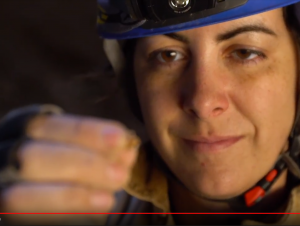
Jenny McGuire, an assistant professor in the School of Earth and Atmospheric Sciences and the School of Biological Sciences, has a tough commute to her summer research site: an 80-foot drop into a deep, dark Wyoming cave. McGuire studies fossils to better understand climate change’s impact on animal and human populations.
Experts In The News
Researchers have long known that when two galaxies approach each other and merge, the supermassive black holes at their centers form a pair and are eventually expected to merge as well. It is precisely these mergers that are considered one of the sources of the gravitational-wave background — a faint “hum” of spacetime detected in recent years. However, the role played by the geometry of the collision in this process has remained an open question.
Graduate student Sena Ghobadi of the Georgia Institute of Technology’s School of Physics, along with her colleagues, has developed three-dimensional dynamic models of such collisions.
A similar story appeared in Sky & Telescope.
Universe Magazine April 28, 2026Zachary Handlos, senior academic professional in the School of Earth and Atmospheric Sciences, explains how weather patterns can lead to conditions conducive to the types of wildfires currently seen in Florida and Georgia.
This piece also appeared in The Washington Post and The Conversation.
Atlanta Journal Constitution April 25, 2026