To request a media interview, please reach out to experts using the faculty directories for each of our six schools, or contact Jess Hunt-Ralston, College of Sciences communications director. A list of faculty experts is also available to journalists upon request.
News Center
Latest News
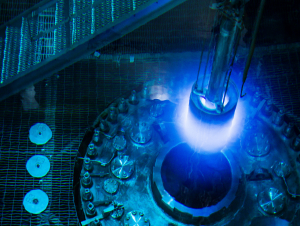
A pioneering glimpse inside elusive cell membranes illuminates a player in cell health but also in hepatitis C and in Alzheimer's. With the most powerful research neutron beams in the country, researchers open a portal into the hidden world of intramembrane proteins, which a third of the human genome is required to create.
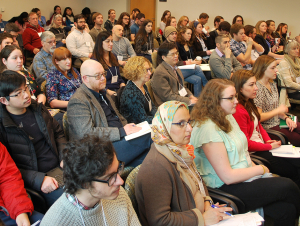
Annual two-day event showcases thought leaders in microbiology research from Georgia Tech and beyond
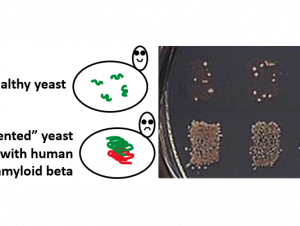
Abnormal proteins called amyloids are strongly implicated in Alzheimer's disease and other deadly diseases. Researchers have not been able to explain how harmless, normal protein sequences go awry and assume the deadly amyloid shape. To study the initial amyloid nucleation, Georgia Tech researchers and their collaborators turned to yeast as a model to study the human amyloids. The researchers successfully applied the method to several proteins, allowing for deeper understanding of abnormal protein aggregation.

The good news is that we don't need special eyeglasses to watch the Jan. 31, 2018, lunar eclipse. The bad news is that we won't see totality as the moon will set before it happens.
Researchers have published the first part of what they expect to be a database showing the kinetics involved in producing colloidal metal nanocrystals – which are suitable for catalytic, biomedical, photonic and electronic applications – through an autocatalytic mechanism.
Strange things happen at ultracold temperatures, when thermal energy is removed from a system and what remains is only the intrinsic energy of the particles in it. So-called quantum systems are the subject of intense curiosity, because of the interesting materials they have yielded.
Experts In The News
Zachary Handlos, Georgia Tech atmospheric science educator, explains how drought, heat, and shifting weather patterns are fueling more intense Southeast wildfires.
11Alive News May 6, 2026Less than a month after the historic Artemis II mission began, a Georgia Tech researcher is being recognized for his work in helping keep astronauts safe in space.
Thomas Orlando, a Regents’ professor at Georgia Tech, designed the spacesuits worn by astronauts on Artemis 2. He said his team focused on protecting the suits from micrometeorite impacts and especially lunar dust.
“We realized that a bigger problem, at least from NASA’s perspective, is dust," Orlando said. “We don’t really want dust to be on spacesuits. It can get into the seals. It could, you know, cause them to leak.”
Orlando works with graduate students to study the challenges astronauts may face in space and on the moon.
WJCL 22 Savannah May 5, 2026