To request a media interview, please reach out to experts using the faculty directories for each of our six schools, or contact Jess Hunt-Ralston, College of Sciences communications director. A list of faculty experts is also available to journalists upon request.
News Center
Latest News

February is Black History Month, a special time set aside to celebrate the contributions of African Americans. The College of Sciences joins the celebration by inviting the perspectives of African-American colleagues through a two-part Q&A.

Jenny McGuire is one of several scientists featured in a documentary that WyomingPBS will air twice in February.

February is Black History Month, a special time set aside to celebrate the contributions of African Americans. The College of Sciences joins the celebration by inviting the perspectives of African-American colleagues through a two-part Q&A.
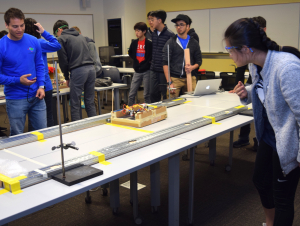
CEISMC hosted a Division C regional tournament for the Science Olympiad, a nationally recognized competition for enhancing science education and interest. The regional tournament took place at Georgia Tech in the G. Wayne Clough Undergraduate Learning Commons.
First-passage percolation (FPP) is a simplified model to describe growth in a random medium. The field has grown rapidly in the past 10 years, but the last comprehensive survey of the field took place in the 1980’s. This book summarizes the state of the art for graduate students and researchers planning to work on this topic.
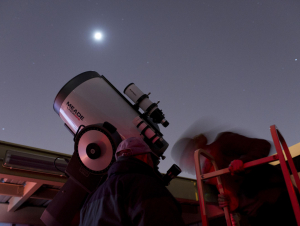
The next time you are outside on a cloudless night, look up at the stars. If they look brighter or seem clearer during these winter nights, it’s not your imagination. Winter is actually better than summer when it comes to sky gazing.
Experts In The News
Researchers have long known that when two galaxies approach each other and merge, the supermassive black holes at their centers form a pair and are eventually expected to merge as well. It is precisely these mergers that are considered one of the sources of the gravitational-wave background — a faint “hum” of spacetime detected in recent years. However, the role played by the geometry of the collision in this process has remained an open question.
Graduate student Sena Ghobadi of the Georgia Institute of Technology’s School of Physics, along with her colleagues, has developed three-dimensional dynamic models of such collisions.
A similar story appeared in Sky & Telescope.
Universe Magazine April 28, 2026Zachary Handlos, senior academic professional in the School of Earth and Atmospheric Sciences, explains how weather patterns can lead to conditions conducive to the types of wildfires currently seen in Florida and Georgia.
This piece also appeared in The Washington Post and The Conversation.
Atlanta Journal Constitution April 25, 2026