To request a media interview, please reach out to experts using the faculty directories for each of our six schools, or contact Jess Hunt-Ralston, College of Sciences communications director. A list of faculty experts is also available to journalists upon request.
News Center
Latest News

The duo of Earth and Atmospheric Sciences associate professors are among 20 Scialog® winners of $1.1 million in funding from four organizations, including NASA, for new approaches that could transform our understanding of the habitability of planets. Glass and Reinhard are also among AGU’s latest cohort of annual awardees.
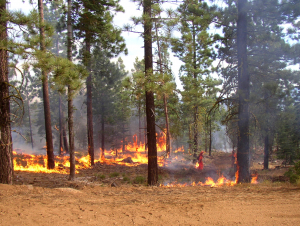
A $1 million award from the U.S. Environmental Protection Agency will help researchers develop tactics to protect children from harmful emissions from controlled wildland burns. The initiative will provide equipment and new communications approaches in middle and high schools in Albany and Columbus, Ga., and Phenix City, Ala.
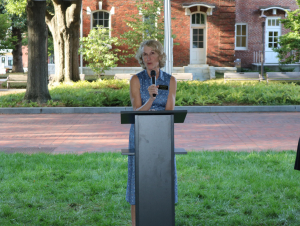
The September Sciences Celebration, staged outdoors at Harrison Square on September 9, 2021 by the College of Sciences Office of the Dean, welcomed new faculty and presented 2020-2021 awards to a number of faculty and a fourth year student in the School of Mathematics.

Bringing together a wide range of local and global experts to showcase climate change solutions, the event will be held in a fully virtual, online format for the second year due to the pandemic.

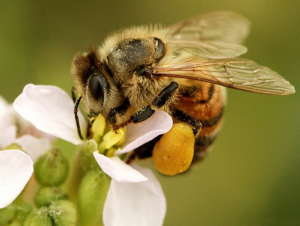
New research led by Georgia Tech’s College of Engineering finds that honey bees have developed a way to transform pollen particles into a viscoelastic pellet, allowing them to transport pollen efficiently, quickly, and reliably to their hive. The study also suggests the insects remove pollen from their bodies at speeds 2-10 times slower than their typical grooming speeds.
Experts In The News
Alex Robel, an associate professor in the School of Earth and Atmospheric Sciences at Georgia Tech, said pumping sand onshore is far from a perfect solution to stabilize a beach, but it’s “one of the best tools we have in our arsenal.”
“It’s been done in the United States for almost a century in different places and we know how to do it,” Robel said. “We’re good at it.”
But nourishment is only a Band-Aid for erosion. Once cities start replenishing sand, Robel said they have to keep doing it regularly.
Atlanta Journal Constitution March 24, 2026A team of researchers including David Hu, a professor in Georgia Tech’s School of Biological Sciences and George W. Woodruff School of Mechanical Engineering, have visualized mosquito flight behavior for the first time.
Based on their data, the researchers said they don’t think mosquitoes swarm because they’re following the pack. Each appeared to pick up on the cues independently, then found themselves at the same place at the same time.
“It’s like a crowded bar,” said Hu. “Customers aren’t there because they followed each other into the bar. They’re attracted by the same cues: drinks, music, and the atmosphere. The same is true of mosquitoes. Rather than following the leader, the insect follows the signals and happens to arrive at the same spot as the others. They’re good copies of each other.”
A similar story was published by The Economic Times.
ScienceDaily March 22, 2026