To request a media interview, please reach out to experts using the faculty directories for each of our six schools, or contact Jess Hunt-Ralston, College of Sciences communications director. A list of faculty experts is also available to journalists upon request.
News Center
Latest News
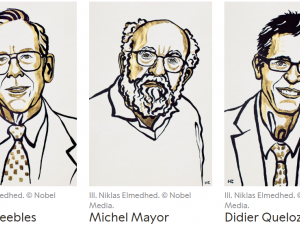
The 2019 Nobel Prize in Physics was awarded "for contributions to our understanding of the evolution of the universe and Earth's place in the cosmos." Georgia Tech scientists John Wise, Gongjie Li, and Chris Reinhard reflect on the award-winning work and its impact on their own research.

First-year biochemistry major Baylor Reini wins quiz 3 of ScienceMatters Season 3.
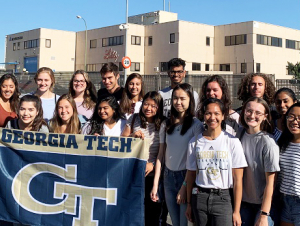
Lilly Espana, in Alcobendas, Spain, hosted 24 Georgia Tech undergraduate students and two faculty, as part of the College of Sciences’ Barcelona Fall study abroad program.
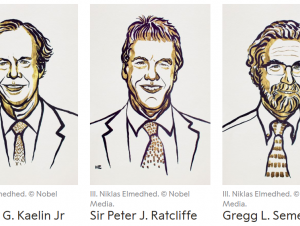
The 2019 Nobel Prize in Physiology or Medicine was awarded jointly to William G. Kaelin Jr., Sir Peter J. Ratcliffe, and Gregg L. Semenza “for their discoveries of how cells sense and adapt to oxygen availability.” Georgia Tech assistant professors Amit Reddi and Young Jang reflect on the downstream effects of the award-winning work.
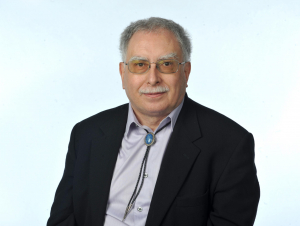
Mathematical concepts that have been around for centuries could help NASA save on fuel for future trips to the solar system's outer planets and moons, thanks to research from School of Mathematics Professor Rafael de la Llave.
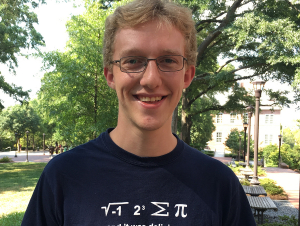
Benjamin Breer is a second-year student doing a double major in physics and aerospace engineering. Last summer, while still a first-year student, he submitted his first first-author paper – “Energetic Ion Dynamics in the Perturbed Electromagnetic Fields near Europa” – to the Journal of Geophysical Research: Space Physics, which published the work on Sept. 6. The findings have significance for missions to search for life on Europa, a moon of Jupiter that is high on NASA’s list of places outside Earth to explore for life. The paper is likely to be the first of many scientific reports from Breer, who says, “I always feel like there is something else to be discovered.”
Experts In The News
In December, The Conversation hosted a webinar on AI’s revolutionary role in drug discovery and development. Science and technology editor Eric Smalley interviewed Jeffrey Skolnick, Regents' Professor and eminent scholar in computational systems biology at Georgia Institute of Technology, and Benjamin P. Brown, assistant professor of pharmacology at Vanderbilt University. Skolnick has developed AI-based approaches to predict protein structure and function that may help with drug discovery and finding off-label uses of existing drugs. Brown’s lab works on creating new computer models that make drug discovery faster and more reliable.
The Conversation April 7, 2026While it often gets written off as being distracted or not paying attention, daydreaming is actually a sign of an active and imaginative mind. In fact, a 2017 study found that daydreamers are generally smarter than their focused peers. “People with efficient brains may have too much brain capacity to stop their minds from wandering,” said Eric Schumacher, the Georgia Tech psychology professor who co-authored the study.
People who daydream frequently have things running through their heads, whether they are thinking through ideas or picturing possible outcomes. Letting the mind wander allows unexpected connections to form. To an outside observer, they may seem checked out of reality. However, other highly intellectual people know that they're truly deeply engaged, just not with what's going on right in front of them.
Your Tango April 4, 2026