To request a media interview, please reach out to experts using the faculty directories for each of our six schools, or contact Jess Hunt-Ralston, College of Sciences communications director. A list of faculty experts is also available to journalists upon request.
News Center
Latest News
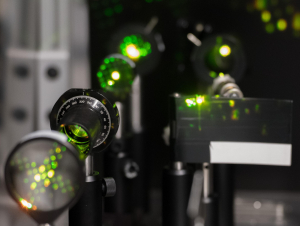
It defies conventional wisdom about semiconductors. It's baffling that it even works. It eludes physics models that try to explain it. This newly tested class of light-emitting semiconductors is so easy to produce from solution that it could be painted onto surfaces to light up our future in myriad colors shining from affordable lasers, LEDs, and even window glass.
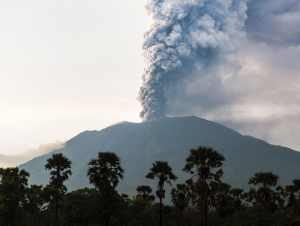
The Alumni Magazine thought it would be a blast to talk to Dufek about his work at Tech and find out if we’re all inevitably doomed to die under mounds of volcanic ash and lava.
The College of Sciences applauds faculty members who earned promotions and/or tenure in 2017-18.
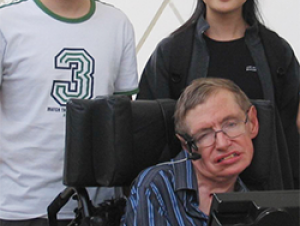
Stephen Hawking's death on March 14 – Albert Einstein's birthday – brought an end to the legendary career of the world-reknowned physicist and cosmologist. Hawking's groundbreaking work on black holes inspired several College of Sciences researchers in their own studies about the nature of the universe.
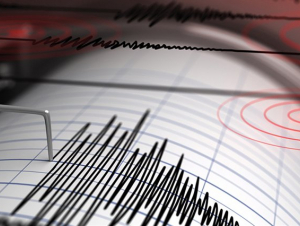
Many of us grew up thinking of California as the epicenter of most earthquake activity in the United States. (It’s really Alaska.) But today, in the contiguous U.S., most of the major tremors—magnitude 3 or higher—actually occur in Oklahoma. And these tremors don’t appear to come from wholly natural causes.
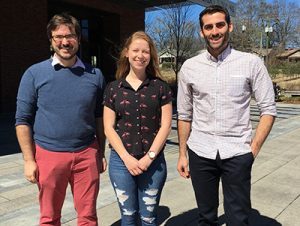
Three graduate students from College of Sciences attended the inaugural Communicating Science Conference—Atlanta (ComSciCon-Atlanta), held on March 1-2, 2018, at Georgia Tech. Like the 46 other participants, they wanted to improve how to talk to nonscientists about their research.
Experts In The News
Researchers have long known that when two galaxies approach each other and merge, the supermassive black holes at their centers form a pair and are eventually expected to merge as well. It is precisely these mergers that are considered one of the sources of the gravitational-wave background — a faint “hum” of spacetime detected in recent years. However, the role played by the geometry of the collision in this process has remained an open question.
Graduate student Sena Ghobadi of the Georgia Institute of Technology’s School of Physics, along with her colleagues, has developed three-dimensional dynamic models of such collisions.
A similar story appeared in Sky & Telescope.
Universe Magazine April 28, 2026Zachary Handlos, senior academic professional in the School of Earth and Atmospheric Sciences, explains how weather patterns can lead to conditions conducive to the types of wildfires currently seen in Florida and Georgia.
This piece also appeared in The Washington Post and The Conversation.
Atlanta Journal Constitution April 25, 2026